 Ghar Se Padhai
1. Introduction
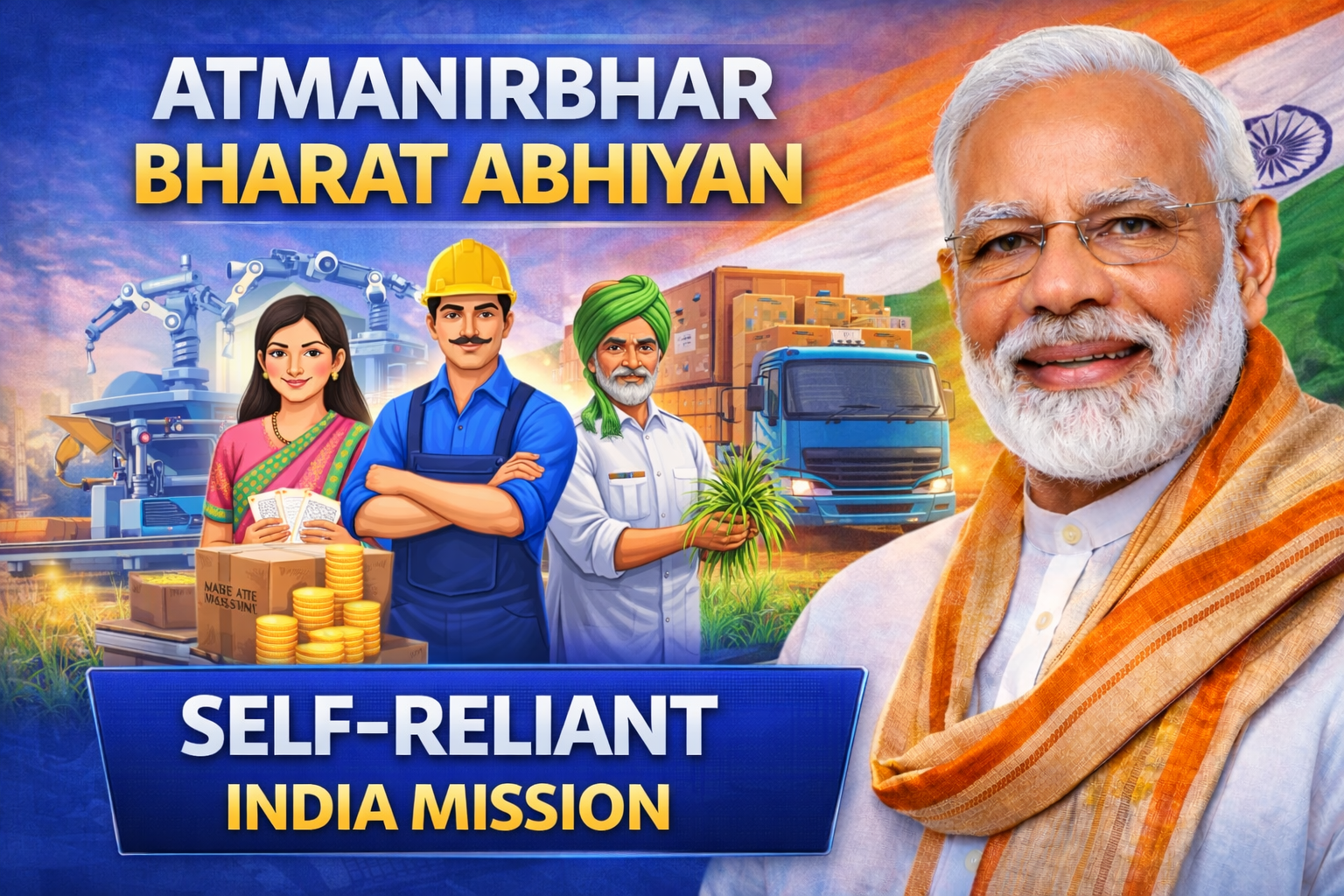
Atmanirbhar Bharat Abhiyan is one of the most ambitious and transformative national initiatives launched by the Government of India to make the country self-reliant, strong, and globally competitive. The phrase “Atmanirbhar Bharat” means Self-Reliant India. The idea is not to isolate India from the world, but to build strong domestic capabilities so that India can confidently participate in global trade while depending less on critical imports.
The concept of self-reliance has deep roots in India’s freedom movement, but in the modern economic context, Atmanirbhar Bharat represents a strategic shift in development policy. It focuses on strengthening domestic manufacturing, encouraging innovation, supporting small and medium enterprises, improving infrastructure, and making Indian industries more competitive on the global stage.
The Atmanirbhar Bharat Abhiyan was announced in May 2020, during the COVID-19 pandemic, when the global economy was facing severe disruptions. Lockdowns, broken supply chains, and falling demand exposed how dependent many countries were on a few global suppliers. India also faced challenges such as:
- Disruption of imports of essential goods
- Job losses and business closures
- Pressure on small businesses and informal workers
- Need for economic revival and structural reforms
In this difficult situation, the Government of India announced a large economic and reform package under the banner of Atmanirbhar Bharat Abhiyan. The goal was not just short-term relief, but long-term transformation of the Indian economy.
2. Meaning and Concept of Atmanirbhar Bharat
The word Atmanirbhar comes from two Sanskrit words:
- Atma = Self
- Nirbhar = Dependent
So, Atmanirbhar Bharat means an India that is self-dependent or self-reliant.
However, the vision of Atmanirbhar Bharat is not about closing doors to the world. Instead, it is about:
- Building strong domestic industries
- Reducing unnecessary dependence on imports
- Increasing India’s share in global value chains
- Making Indian products globally competitive
- Encouraging innovation, quality, and efficiency
The Prime Minister explained that Atmanirbhar Bharat is about:
“Making India a bigger and more important part of the global economy by strengthening our own capabilities.”
In simple words, it means:
India should produce more, innovate more, export more, and depend less on others for critical needs—while still being open to global trade and cooperation.
3. Background: Why Was Atmanirbhar Bharat Abhiyan Needed?
3.1 Global Economic Disruptions and COVID-19
The COVID-19 pandemic caused:
- Lockdowns across countries
- Disruption of global supply chains
- Shortage of medical equipment, medicines, and essential goods
- Fall in industrial production and trade
- Job losses and business failures
Many countries realized that over-dependence on a few global suppliers was risky. India also faced:
- Difficulty in importing some critical items
- Pressure on domestic industries
- Need to protect jobs and revive growth
This situation highlighted the importance of strong domestic production and self-sufficiency in key sectors.
3.2 India’s Structural Economic Challenges
Even before the pandemic, India faced some long-term challenges:
- Heavy dependence on imports in certain sectors (electronics, defense, medical equipment, etc.)
- Weaknesses in manufacturing compared to services
- Problems faced by MSMEs (Micro, Small and Medium Enterprises) such as lack of credit and technology
- Infrastructure gaps and logistics inefficiencies
- Need for reforms in agriculture, labor, and markets
Atmanirbhar Bharat Abhiyan was designed to address these structural issues along with providing pandemic-related relief.
3.3 Opportunity for Reform and Renewal
Crises often create opportunities for change. The government used this moment to:
- Push long-pending economic reforms
- Encourage domestic manufacturing and investment
- Strengthen supply chains within India
- Make the economy more resilient, competitive, and future-ready
4. Objectives of Atmanirbhar Bharat Abhiyan
The main objectives of Atmanirbhar Bharat Abhiyan are:
- Make India self-reliant in key sectors
- Reduce dependence on imports for critical goods.
- Boost domestic manufacturing and production
- Encourage “Make in India” and “Make for the World”.
- Strengthen MSMEs and startups
- Support small businesses, which are the backbone of the economy.
- Create jobs and support livelihoods
- Promote entrepreneurship and industrial growth.
- Improve competitiveness and productivity
- Focus on quality, efficiency, and innovation.
- Integrate India with global value chains
- Increase exports and India’s role in world trade.
- Build a resilient and sustainable economy
- Prepare India to handle future global shocks better.
5. The Five Pillars of Atmanirbhar Bharat
The vision of Atmanirbhar Bharat is based on five key pillars:
5.1 Economy
- A quantum jump in economic growth, not just incremental change.
- Focus on structural reforms, not temporary fixes.
- Build a strong, dynamic, and competitive economy.
5.2 Infrastructure
- Infrastructure as the identity of modern India.
- Better roads, railways, ports, airports, digital networks, and logistics.
- Infrastructure development to support industry and growth.
5.3 System
- Technology-driven and transparent systems.
- Reforms in governance, regulations, and public services.
- Use of digital platforms for efficiency and inclusion.
5.4 Vibrant Demography
- India’s young population as a source of strength.
- Skill development, education, and employment opportunities.
- Empowering youth to drive innovation and growth.
5.5 Demand
- Strengthening domestic demand and supply chains.
- Using the power of India’s large market to boost production.
- Supporting both consumers and producers.
6. Major Components of Atmanirbhar Bharat Abhiyan
The Atmanirbhar Bharat package included economic relief, reforms, and long-term structural measures. Some of the major components are discussed below.
6.1 Support to MSMEs
MSMEs are the backbone of the Indian economy. They:
- Provide large-scale employment
- Contribute significantly to GDP and exports
- Support local industries and entrepreneurship
Under Atmanirbhar Bharat:
- Collateral-free loans were announced for MSMEs.
- Subordinate debt and equity support were provided to stressed MSMEs.
- The definition of MSMEs was revised to allow them to grow without losing benefits.
- Efforts were made to improve credit access, technology, and market linkages.
This helped MSMEs survive the crisis and prepare for future growth.
6.2 Reforms in Agriculture
Agriculture supports a large part of India’s population. Atmanirbhar Bharat introduced reforms to:
- Give farmers more freedom to sell their produce
- Improve storage, processing, and supply chains
- Encourage private investment in agriculture
- Reduce wastage and improve farmers’ incomes
The aim was to make agriculture more market-oriented, efficient, and profitable for farmers.
6.3 Boost to Manufacturing and Production-Linked Incentives (PLI)
To promote domestic manufacturing, the government launched Production-Linked Incentive (PLI) schemes in several sectors such as:
- Electronics and mobile phones
- Pharmaceuticals
- Automobiles and auto components
- Textiles
- Solar panels and batteries
- Telecom equipment
Under PLI:
- Companies get incentives based on increased production in India.
- The goal is to:
- Attract investment
- Build large-scale manufacturing capacity
- Increase exports
- Create jobs
This is a major step towards making India a global manufacturing hub.
6.4 Defense and Strategic Sectors
India has traditionally imported a large part of its defense equipment. Under Atmanirbhar Bharat:
- More items were banned from import and encouraged to be made in India.
- The defense sector was opened more to private participation.
- Efforts were made to promote indigenous research, design, and production.
This helps in:
- Improving national security
- Saving foreign exchange
- Developing advanced technology within the country
6.5 Infrastructure and Construction
Infrastructure development is key to economic growth. The Abhiyan emphasized:
- Investment in roads, railways, ports, airports, and logistics
- Support to housing and construction sectors
- Faster project approvals and better coordination
Strong infrastructure reduces costs, improves efficiency, and makes Indian industries more competitive.
6.6 Financial Sector and Liquidity Support
To ensure that businesses and individuals have access to funds:
- The government and RBI took steps to increase liquidity in the system.
- Support was given to:
- Banks
- NBFCs
- Small finance institutions
- Measures were introduced to:
- Improve credit flow
- Reduce financial stress
- Stabilize markets
This helped in preventing a financial crisis and supporting economic recovery.
7. Role of Technology and Digital India
Technology plays a central role in Atmanirbhar Bharat:
- Digital platforms for:
- Payments
- Governance
- Business services
- Promotion of:
- Startups
- Innovation
- Research and development
- Use of:
- Artificial intelligence
- Data
- Automation
- Digital infrastructure
Digital India supports:
- Transparency
- Efficiency
- Inclusion
- Faster growth and innovation
8. Atmanirbhar Bharat and Globalization
Atmanirbhar Bharat does not mean isolation or protectionism. Instead, it means:
- Stronger participation in global trade
- More exports and better quality products
- Less dependence on critical imports
- More resilient supply chains
India aims to:
- Become a reliable global manufacturing and supply hub
- Attract foreign investment
- Integrate more deeply with global value chains
In short, Atmanirbhar Bharat is about being “self-reliant and globally engaged” at the same time.
9. Achievements and Early Impact
Some visible impacts and trends include:
- Growth in domestic manufacturing in sectors like electronics and pharmaceuticals
- Increased focus on startups, innovation, and local production
- Expansion of PLI schemes and investment commitments
- Greater awareness about “Vocal for Local” and Indian products
- Strengthening of digital and infrastructure ecosystems
While transformation takes time, the direction of policy shows a clear shift towards building domestic capabilities.
10. Challenges and Criticisms
Despite its strong vision, Atmanirbhar Bharat faces some challenges:
10.1 Implementation Issues
- Reforms need strong coordination between:
- Central government
- State governments
- Private sector
- Bureaucratic delays and regulatory hurdles can slow progress.
10.2 Risk of Protectionism
- Some critics worry that too much focus on self-reliance could:
- Reduce competition
- Increase costs
- The challenge is to balance:
- Domestic support
- Global competitiveness
10.3 Skill and Technology Gaps
- To become truly self-reliant, India needs:
- Better skills
- More R&D
- Stronger education and training systems
10.4 Fiscal Pressure
- Large incentive and support packages:
- Increase government spending
- Put pressure on public finances
- Long-term sustainability requires:
- Higher growth
- Better tax revenues
- Efficient spending
11. Long-Term Significance of Atmanirbhar Bharat
In the long run, Atmanirbhar Bharat can:
- Transform India into a strong manufacturing and innovation hub
- Create millions of jobs
- Improve economic resilience against global shocks
- Increase India’s share in global trade
- Strengthen national security and strategic autonomy
- Promote inclusive and sustainable development
12. Conclusion
Atmanirbhar Bharat Abhiyan is not just an economic package—it is a vision for India’s future. It represents a shift from dependence to self-confidence, from vulnerability to resilience, and from limited capability to global competitiveness.
By focusing on manufacturing, MSMEs, infrastructure, technology, reforms, and innovation, the Abhiyan aims to build an India that is:
- Strong at home
- Confident in the world
- Capable of facing future challenges
- Committed to inclusive growth
While challenges remain, the success of Atmanirbhar Bharat will depend on:
- Consistent reforms
- Effective implementation
- Cooperation between government, industry, and society
- Investment in skills, technology, and innovation
In essence, Atmanirbhar Bharat is about building a self-reliant India that contributes more to the world while standing firmly on its own strengths—an India that is not just a participant in the global economy, but a leader and a reliable partner in shaping the future.