 Ghar Se Padhai
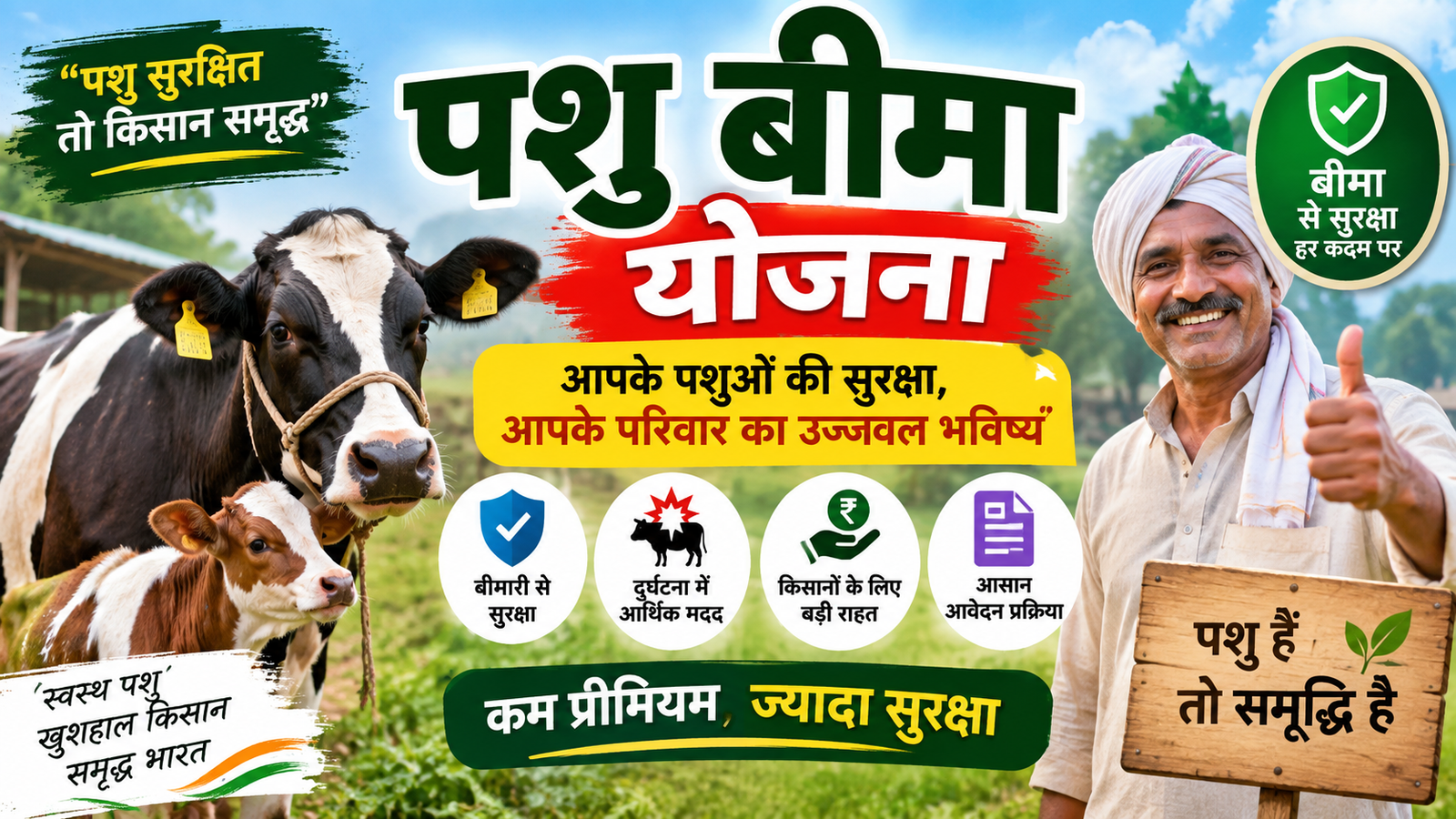
Pashu Bima Yojana (Livestock Insurance Scheme) in India — Complete Detailed Guide
Pashu Bima Yojana, commonly understood as Livestock Insurance, is a government-supported insurance mechanism designed to protect livestock owners from financial loss when insured animals die because of covered risks. At the central-government level, livestock insurance is implemented under the National Livestock Mission (NLM) through its Livestock Insurance activity. The Department of Animal Husbandry & Dairying (DAHD), Ministry of Fisheries, Animal Husbandry & Dairying, Government of India, is responsible for the national framework. (Animal Husbandry and Dairying)
The important point is that this is not simply a scheme where the government gives a fixed amount of money whenever an animal dies. It is an insurance arrangement in which the animal is insured for an assessed value, a premium is paid, and government support reduces the farmer's premium burden. If a covered insured animal subsequently dies and the claim satisfies the policy conditions, the insurance company pays the admissible claim.
The scheme is particularly relevant to people who depend on cows, buffaloes, sheep, goats, pigs, horses, donkeys, mules, camels and other livestock for milk, breeding, agriculture, transport or livelihood.
Important: The rules below reflect the current national framework I could verify from Government of India sources, including the modified National Livestock Mission guidelines. State-level implementation can differ in practical details such as the insurance company, application procedure, camps, veterinary certification and availability.
1. What is Pashu Bima Yojana?
In simple language:
Pashu Bima Yojana = insurance protection for your livestock.
Suppose a farmer owns a valuable milch cow worth ₹70,000. The cow represents a significant financial asset. If the animal unexpectedly dies because of a covered risk, the farmer may lose a large portion of his/her livelihood.
Livestock insurance attempts to reduce that financial risk.
The basic process is:
Farmer owns animal → animal is identified and valued → insurance policy is issued → premium is paid → government provides eligible premium support → animal remains insured during the policy period → covered death occurs → claim is submitted → veterinary/insurance verification takes place → admissible claim is paid.
The central government's livestock-insurance activity specifically aims to provide protection against the financial risk associated with the death of livestock. (Animal Husbandry and Dairying)
2. Which government department operates it?
At the national level, livestock insurance comes under:
Ministry: Ministry of Fisheries, Animal Husbandry & Dairying
Department: Department of Animal Husbandry & Dairying (DAHD)
Programme: National Livestock Mission (NLM)
Activity: Livestock Insurance
The National Livestock Mission has several components, and livestock insurance is part of the sub-mission covering Research & Development, Livestock Insurance, Extension and Innovation. (Animal Husbandry and Dairying)
Official information is available through the Department of Animal Husbandry & Dairying:
Department of Animal Husbandry & Dairying — National Livestock Mission
3. Why is livestock insurance necessary?
For many rural households, an animal is not merely an animal.
A cow or buffalo may provide:
- Milk
- Calves
- Breeding income
- Manure
- Agricultural support
- Regular household income
- Sale value
- Emergency financial security
For a small farmer, losing one productive animal can therefore have a major economic effect.
For example, imagine:
AssetApproximate valueCow₹70,000Buffalo₹90,000Two goats₹25,000Four sheep₹40,000
If an uninsured buffalo dies, the farmer may lose ₹90,000 of productive capital.
Insurance does not prevent the animal from dying. Instead, it is intended to reduce the financial shock caused by the covered loss.
This is particularly important because livestock ownership is often concentrated among small and marginal farmers and landless rural households.
The government's National Livestock Mission explicitly includes improving risk coverage and supporting livestock-based livelihoods among its objectives. (Animal Husbandry and Dairying)
4. Which animals can be insured?
The national livestock-insurance framework covers a broad range of livestock.
The guidelines include:
Large animals
- Indigenous cattle
- Crossbred cattle
- Milch animals
- Buffaloes
- Certain pack animals
Other livestock
Depending on implementation and policy:
- Sheep
- Goats
- Pigs
- Rabbits
- Horses
- Donkeys
- Mules
- Camels
- Ponies
- Yak
- Mithun
- Other eligible livestock
The earlier national guidelines specifically identify indigenous/crossbred milch animals, pack animals and several categories of other livestock within the insurance framework. (Animal Husbandry and Dairying)
However, do not assume that every animal in every location is automatically eligible. The actual policy issued by the implementing agency/insurance company determines the animals, age limits, valuation requirements and covered risks.
5. What is a "Cattle Unit"?
This is particularly important for sheep, goats, pigs and rabbits.
Under the current framework:
1 cattle unit = 10 small animals, such as:
- 10 sheep
- 10 goats
- 10 pigs
- 10 rabbits
This conversion is used when determining the subsidised number of animals. (Animal Husbandry and Dairying)
For example:
Example 1
A farmer has:
20 goats
That equals:
20 ÷ 10 = 2 cattle units
Example 2
A farmer has:
50 goats
That equals:
50 ÷ 10 = 5 cattle units
Example 3
A farmer has:
100 goats
That equals:
100 ÷ 10 = 10 cattle units
The maximum eligible number for subsidy is important because the farmer can potentially insure additional animals by paying the full premium where the rules permit, but government subsidy is subject to the applicable limits.
6. How many animals can receive the subsidy?
This is one of the areas where older information on the internet can be misleading.
The earlier NLM guidelines had a lower limit. However, the Government of India subsequently modified the livestock-insurance component.
The modified framework increased the subsidised coverage from 5 cattle units to 10 cattle units per household for most eligible animals, while the limit for pigs and rabbits remains 5 cattle units per household. (Animal Husbandry and Dairying)
Therefore, don't rely on an old website saying:
"Only 5 animals can be insured."
That statement may be referring to an earlier version of the scheme.
The current framework is more generous in terms of the number of animals eligible for subsidised insurance.
7. Who can benefit?
The scheme is primarily intended to support livestock owners and farmers.
Potential beneficiaries include people keeping livestock for:
- Dairy
- Agriculture
- Breeding
- Meat production
- Wool
- Transport
- Rural livelihood
- Small-scale livestock farming
The exact eligibility and implementation process can be determined by the State Animal Husbandry Department and the insurance programme operating in that state.
The scheme is designed to make livestock insurance more accessible by reducing the farmer's premium burden.
8. How much premium does the farmer have to pay?
This is one of the biggest changes in the modified livestock-insurance framework.
The Government of India stated in a 2024 Lok Sabha answer that the beneficiary's share of the insurance premium was reduced to:
15%
for all categories and areas under the modified arrangement.
The remaining premium is shared between the Central and State Governments according to the applicable funding pattern. (Animal Husbandry and Dairying)
For normal states, the Central-State sharing of the subsidised premium component is 60:40.
For Himalayan/North-Eastern states, it is 90:10.
For Union Territories, the Central Government provides 100% of the government share. (Animal Husbandry and Dairying)
So, conceptually:
Total insurance premium = Government-supported portion + beneficiary contribution
The beneficiary's share under the modified national framework is 15%, subject to the applicable guidelines and policy implementation.
9. Example of premium calculation
Suppose an insurance company determines that:
Annual premium = ₹4,000
If the applicable beneficiary share is 15%:
₹4,000 × 15% = ₹600
So the farmer's contribution would be approximately:
₹600
The remaining:
₹4,000 − ₹600 = ₹3,400
would be covered through the government funding arrangement, subject to the scheme's rules and actual implementation.
Another example
Suppose:
Premium = ₹10,000
Farmer's 15% share:
₹10,000 × 15% = ₹1,500
Government-supported portion:
₹10,000 − ₹1,500 = ₹8,500
This is only an illustrative calculation. The actual premium depends on the animal's value, species, policy duration, insurance company, location and applicable rates.
10. Is the government giving ₹50,000, ₹70,000 or ₹1 lakh directly?
No.
This is a very common misunderstanding.
Pashu Bima is not a fixed cash assistance scheme.
For example, suppose your cow is valued and insured for:
₹60,000
and subsequently dies due to a covered cause.
The claim would generally be based on the insured/admissible value and policy terms, not on a universal government payment of ₹50,000 or ₹1 lakh.
The actual amount depends on:
- Insured value
- Policy conditions
- Cause of death
- Documentation
- Veterinary verification
- Identification of animal
- Whether exclusions apply
- Insurance company's assessment
11. How is the value of the animal determined?
Before insurance, the animal generally needs to be valued.
The valuation can depend upon:
- Breed
- Age
- Sex
- Milk production
- Physical condition
- Market value
- Purpose
- Productivity
- Other relevant characteristics
A veterinary professional/authorised person may be involved in determining or certifying the animal's value.
This valuation becomes extremely important because insurance cannot simply be based on an arbitrary amount chosen by the owner.
For example:
If a farmer says:
"My cow is worth ₹2 lakh."
but the authorised valuation determines that its insurable value is ₹80,000, the farmer cannot necessarily demand a ₹2 lakh insurance claim.
The policy's insured value matters.
12. Animal identification
Identification is an important part of livestock insurance.
The animal must be linked to the insurance policy so that the insurer can establish that the animal for which a claim is being made is the same animal that was insured.
Identification may involve:
- Ear tags
- Unique identification numbers
- Photographs
- Other approved identification systems
- RFID
The modified programme specifically approved Radio Frequency Identification Device (RFID) as an identification method in addition to existing identification systems. (Animal Husbandry and Dairying)
This is important for preventing:
- Fraud
- Substitution of animals
- Duplicate claims
- Identity disputes
13. What happens if the insured animal dies?
This is the most important part for a livestock owner.
Suppose your insured buffalo dies.
You should immediately inform the insurance company/authorised agency and the relevant veterinary authority according to your policy instructions.
Do not simply bury or dispose of the animal before the required inspection.
The insurer may require:
- Intimation of death
- Veterinary examination
- Post-mortem report where applicable
- Insurance policy
- Animal identification
- Ear tag/RFID details
- Photographs
- Claim form
- Bank details
- Ownership documents
- Veterinary certificate
- Other supporting documents
The exact documentation can vary according to the insurance company and state implementation.
14. Why should you not dispose of the carcass immediately?
Because the insurer may need to verify:
1. Whether the insured animal actually died
2. Whether the animal corresponds to the insured identification
3. The cause of death
4. Whether the death is covered
5. Whether there are indications of fraud
Therefore, if an animal dies, contact the authorised person as soon as possible.
The biggest mistake a livestock owner can make is waiting several days and then attempting to file a claim without proper verification.
15. What deaths are covered?
The answer depends on the specific insurance policy.
Generally, livestock insurance is intended to provide protection against death due to covered risks.
However, not every possible death is necessarily covered.
Insurance policies normally contain:
- Covered risks
- Exclusions
- Waiting periods
- Conditions
- Documentation requirements
- Claim procedures
For example, an insurer may have specific exclusions relating to:
- Deliberate killing
- Fraud
- Certain diseases
- Negligence
- Pre-existing conditions
- Improper identification
- Policy violations
Therefore, always read the policy wording rather than assuming that every death automatically qualifies.
16. Does Pashu Bima cover illness?
This is another important distinction.
Livestock insurance is primarily about financial protection against insured risks, particularly death.
It should not be confused with a comprehensive veterinary health-insurance programme that pays every medical bill.
For example:
Your cow gets a minor infection.
You take the cow to a veterinarian.
The treatment costs ₹2,000.
That does not automatically mean Pashu Bima will reimburse ₹2,000.
Livestock insurance and veterinary healthcare are different concepts.
The government separately operates programmes dealing with livestock health, vaccination and veterinary services.
For example, the Livestock Health and Disease Control Program (LHDCP) focuses on disease prevention, vaccination, veterinary services and disease control. (Animal Husbandry and Dairying)
17. Difference between Pashu Bima and veterinary treatment
Pashu BimaVeterinary treatmentInsurance/risk protectionMedical carePrimarily protects against covered livestock deathTreats sick/injured animalsInsurance premium is paidConsultation/treatment may have costClaim may be filed after covered deathTreatment occurs while animal is aliveInsurance company handles claimVeterinary service handles treatment
Both are important but they serve different purposes.
18. What documents may be required?
The exact list depends on the state and insurer, but a livestock owner may be asked for:
Farmer documents
- Aadhaar/identity document
- Address details
- Mobile number
- Bank account details
- Passbook/cancelled cheque
- Passport-size photograph
Animal documents
- Animal identification/tag number
- RFID number, where applicable
- Photographs
- Breed details
- Age
- Sex
- Veterinary valuation
- Health certificate
Insurance documents
- Insurance policy
- Premium receipt
- Proposal form
- Certificate of insurance
Claim documents
After death:
- Claim form
- Death intimation
- Veterinary certificate
- Post-mortem report where required
- Identification details
- Photographs
- Bank details
- Other documents requested by insurer
Do not assume that every state requires exactly the same documents.
19. How to apply for Pashu Bima?
The application process can vary by state.
A practical route is:
Step 1 — Contact your local Animal Husbandry Department
Go to your:
Block Veterinary Hospital / Veterinary Dispensary / District Animal Husbandry Office
and ask specifically about:
Livestock Insurance under National Livestock Mission
Step 2 — Ask whether enrolment is currently open
Government schemes may be implemented through state-level annual plans and selected insurance companies.
Step 3 — Get your animal examined
The authorised veterinary person may inspect the animal.
Step 4 — Animal valuation
The animal is valued according to the applicable procedure.
Step 5 — Animal identification
The animal receives the required identification.
Step 6 — Insurance proposal
The necessary insurance form is submitted.
Step 7 — Premium
The farmer pays the applicable beneficiary contribution.
Step 8 — Policy issuance
Once approved, the insurance policy/certificate becomes effective according to its terms.
20. Can I insure more animals than the subsidised limit?
Yes, the current guidelines allow beneficiaries to insure additional animals by paying the full premium without receiving the subsidy for those additional animals, subject to the scheme rules.
The current guidelines specifically mention the possibility of insuring more than the subsidised limit by paying the full premium. (Animal Husbandry and Dairying)
This is useful for larger dairy farmers.
For example, suppose the subsidised limit applicable to you is 10 animals.
You own:
15 cows
You may potentially:
- Insure the eligible number with government-supported premium, and
- Insure additional animals using the full premium
subject to the applicable policy and guidelines.
21. Can the insurance be for more than one year?
Yes.
The current guidelines state that efforts should be made to insure animals for at least three years rather than only one year, although implementation can depend on the policy and insurance arrangement. (Animal Husbandry and Dairying)
Longer insurance periods can reduce the administrative burden of renewing the policy every year.
However, always check:
- Policy duration
- Premium
- Renewal conditions
- Claim conditions
- Whether the insurer actually offers the relevant period
22. What if the farmer sells the insured animal?
This is an important issue.
Insurance generally follows the insured interest and policy conditions, not simply the physical animal.
Therefore, if you sell an insured animal:
Do not assume that the insurance automatically transfers to the buyer.
Contact the insurance company or implementing agency.
They can explain whether:
- The policy can be transferred
- The policy must be cancelled
- A new policy is required
- Ownership changes need to be recorded
Failure to update ownership can create serious problems if the animal later dies and a claim is filed.
23. What happens if the animal is stolen?
This depends on the specific insurance policy.
Livestock insurance is primarily designed around covered risks, especially death.
Do not assume theft is automatically covered.
Check the policy wording.
If theft is covered under a particular policy, the claim process will have specific requirements such as:
- Police report
- FIR
- Identification details
- Insurance policy
- Other evidence
But if the policy only covers death and excludes theft, a theft claim may not be payable.
24. What if the animal dies because of an accident?
Again, the answer depends on the policy.
For example:
A buffalo gets injured in an accident and dies.
If accidental death is a covered risk under the applicable livestock insurance policy, the owner may be eligible to file a claim.
But the insurer will normally verify:
- Animal identity
- Policy validity
- Cause of death
- Veterinary evidence
- Whether any exclusion applies
Therefore, the correct approach is:
Inform the insurer immediately.
25. What if an animal dies during treatment?
The answer depends on the policy terms.
Suppose:
A cow becomes seriously ill.
The farmer calls a veterinarian.
Despite treatment, the cow dies.
The death may potentially be covered if the underlying cause falls within the policy's covered risks and the policy conditions have been followed.
The fact that the animal was being treated does not by itself automatically make the claim payable or unpayable.
The insurer must assess the claim under the policy.
26. What if the animal dies because of disease?
This is particularly important.
Different policies may have different provisions for disease-related deaths.
Therefore:
Do not assume that all disease-related deaths are covered.
A livestock owner should ask the insurance provider specifically:
"Which diseases are covered and which diseases are excluded?"
This question should be asked before purchasing the policy.
27. What if the animal dies because of natural causes?
Again, it depends on policy conditions.
The phrase "natural death" is not enough to determine whether a claim is payable.
The insurer may need to determine:
- Age
- Cause of death
- Veterinary findings
- Whether the death falls under an exclusion
- Whether the policy was active
Always obtain the exact policy wording.
28. What is the role of the veterinarian?
The veterinarian is extremely important in the livestock-insurance process.
The veterinary professional may assist with:
- Animal identification
- Health examination
- Valuation
- Health certificate
- Cause-of-death determination
- Post-mortem
- Claim documentation
- Verification
The government framework also provides for payments/honorarium associated with veterinary practitioners under the programme. (Animal Husbandry and Dairying)
29. What is the role of the insurance company?
The insurance company is responsible for the insurance contract.
Its responsibilities can include:
- Issuing the policy
- Collecting/processing premium
- Maintaining policy records
- Verifying claims
- Appointing/using authorised survey or veterinary personnel
- Assessing covered losses
- Approving or rejecting claims based on policy conditions
- Paying admissible claims
The government does not necessarily directly pay the farmer's claim.
Instead, the government helps subsidise the insurance premium under the programme, while the insurance company handles the insurance claim.
30. What is the role of the State Animal Husbandry Department?
The state government has a major role in implementation.
It can be involved in:
- Implementing the scheme
- Selecting/working with insurance companies
- Veterinary verification
- Farmer awareness
- Premium subsidy administration
- Identification systems
- Claim facilitation
- Monitoring
This is why the process can look different in Bihar, Uttar Pradesh, Rajasthan, Maharashtra or another state even though the national framework comes from the Central Government.
31. How does the Central Government contribute?
Under the modified NLM framework, the government-supported premium component is shared between Central and State Governments.
For normal states:
Central : State = 60 : 40
For North-Eastern and Himalayan states:
Central : State = 90 : 10
For Union Territories:
Central = 100%
The farmer's share is separately specified under the modified scheme at 15%. (Animal Husbandry and Dairying)
32. Example: Cow insurance
Let's take a hypothetical example.
A farmer has:
1 crossbred cow
Value determined by authorised assessment:
₹80,000
Suppose the applicable insurance premium is:
₹4,800
Farmer contribution at 15%:
₹4,800 × 15% = ₹720
Government-supported portion:
₹4,800 − ₹720 = ₹4,080
The cow is insured for the applicable amount.
Later, if the cow dies from a covered cause during the policy period:
- Farmer informs the authorised authority/insurer.
- Veterinary inspection takes place.
- Identification is verified.
- Required documents are submitted.
- Claim is assessed.
- If payable, the insurer pays the admissible claim.
33. Example: Goat farmer
Suppose a farmer has:
40 goats
Using:
10 goats = 1 cattle unit
40 goats = 4 cattle units
Therefore, this farmer is within the current subsidised ceiling of 10 cattle units for eligible small livestock categories such as sheep/goats.
Suppose total insurance premium for the 40 goats is:
₹8,000
Farmer contribution at 15%:
₹1,200
The remaining amount is supported according to the government funding mechanism.
If one insured goat subsequently dies:
The claim will depend on:
- Whether that particular goat was identified and insured
- Whether the policy was active
- Whether the cause of death is covered
- Whether the required claim procedure was followed
34. What is not covered automatically?
This is one of the most important sections.
You should not assume that Pashu Bima automatically pays for:
- Every illness
- Every veterinary bill
- Every accident
- Theft
- Every natural death
- Old-age death
- Deliberate killing
- Fraud
- Unidentified animals
- Animals outside the policy
- Death after policy expiry
The exact exclusions depend on the insurance contract.
Insurance is a contract, not unconditional government compensation.
35. Common reasons for claim problems
A farmer can face claim difficulties because of:
1. Animal identification mismatch
The tag/RFID/photo does not match the policy.
2. Delayed death reporting
The farmer informs the insurer too late.
3. No veterinary verification
Required veterinary documentation is missing.
4. Policy expired
The animal died after the policy period ended.
5. Excluded cause of death
The cause falls under a policy exclusion.
6. Wrong documentation
Information in the claim doesn't match the insurance records.
7. Fraud suspicion
The insurer suspects deliberate misrepresentation.
8. Animal sold without updating records
The policy still shows the previous owner.
9. Carcass disposed of before inspection
The insurer cannot properly verify the death.
36. What should a farmer do immediately after animal death?
A very practical checklist:
Within the shortest possible time:
1. Do not dispose of the carcass immediately.
2. Contact the insurance company/authorised representative.
3. Contact the local veterinary officer.
4. Keep the animal identification/tag intact.
5. Take photographs if appropriate and permitted.
6. Keep the policy document ready.
7. Obtain the required veterinary certificate/post-mortem report.
8. Submit the claim form.
9. Keep copies of all documents.
10. Obtain an acknowledgement of claim submission.
This can significantly reduce disputes.
37. Is Aadhaar mandatory?
The exact documentation requirements depend upon the implementing agency and state process.
Identity verification may require documents such as Aadhaar or another accepted identity document.
However, the safest approach is to ask the local Animal Husbandry Department:
"Which identity documents are currently required for livestock insurance in my district?"
Do not rely on an old YouTube video or an outdated blog.
38. Can women livestock owners apply?
Yes, livestock insurance is intended to benefit livestock owners, and women involved in livestock activities can be beneficiaries subject to the applicable eligibility and implementation rules.
This is particularly relevant because livestock activities often contribute significantly to rural household income and women's economic activities.
39. Can small and marginal farmers benefit?
Yes.
In fact, risk protection is particularly important for small livestock owners because a single animal can represent a substantial proportion of their productive assets.
For a large commercial dairy operator:
Losing one cow may be financially manageable.
For a household with only two cows:
Losing one cow can represent 50% of its cattle assets.
Insurance therefore has particular relevance for smaller livestock holders.
40. What is the difference between Pashu Bima and PM-Kisan?
These are completely different.
PM-KISAN
Provides eligible farmer families with direct income support under its own eligibility rules.
Pashu Bima
Provides insurance protection for livestock under the livestock-insurance framework.
PM-KISAN does not mean your animal is automatically insured.
Similarly, buying livestock insurance does not mean you automatically receive PM-KISAN benefits.
41. What is the difference between Pashu Bima and PMFBY?
PMFBY = Pradhan Mantri Fasal Bima Yojana
It is crop insurance.
Pashu Bima = Livestock Insurance
It protects eligible livestock against insured risks.
FeaturePMFBYPashu BimaAssetCropsLivestockExampleWheat, riceCow, buffalo, goatRiskCrop lossCovered livestock loss/deathPolicyCrop insuranceLivestock insuranceDepartmentAgriculture-related systemAnimal Husbandry & Dairying42. Is Pashu Bima available throughout India?
The national framework is intended to support livestock insurance across states through the NLM implementation structure.
The earlier guidelines specifically described implementation in all districts. (Animal Husbandry and Dairying)
However, availability in practice can depend on state implementation, annual planning, participating insurers and local arrangements.
Therefore, if you want to purchase insurance today, the correct practical step is to contact your district Animal Husbandry office.
43. What about Bihar?
Since Bihar is a normal state rather than a North-Eastern/Himalayan state, the NLM funding framework applicable to normal states is relevant at the national level.
The Central-State share for the government-supported premium component under the current NLM framework is:
60:40
and the beneficiary share is specified at:
15%
under the modified national framework. (Animal Husbandry and Dairying)
However, the actual availability, insurer, enrolment camp, local documentation and implementation procedure in a particular Bihar district should be confirmed with Bihar's Animal Husbandry authorities.
For someone in Bihar, a practical first point of contact is generally the:
District Animal Husbandry/Veterinary office or local government veterinary hospital/dispensary.
44. How much compensation will I get?
There is no single nationwide answer such as:
"Every cow gets ₹50,000."
The compensation depends on the insurance policy.
Suppose:
Insured value = ₹75,000
and a covered death occurs.
The admissible claim may be related to that insured amount, subject to:
- Policy conditions
- Identification
- Cause of death
- Applicable exclusions
- Claim assessment
If your animal is insured for ₹75,000, that does not mean every conceivable situation automatically results in a ₹75,000 payment.
45. Can an animal be insured for more than its market value?
Generally, insurance valuation is controlled to prevent over-insurance.
The insurer/authorised veterinary system assesses the animal's insurable value.
Therefore, a farmer generally cannot simply say:
"My goat is worth ₹1 lakh."
and demand a ₹1 lakh policy.
The insurer must accept the valuation according to the applicable rules.
46. Why animal photographs are important
Photographs can help establish:
- Animal identity
- Breed
- Physical characteristics
- Colour
- Horn structure
- Tag number
- Ownership/identification records
A good insurance record should ideally make it difficult to confuse one animal with another.
This is particularly important when a farmer owns multiple similar-looking animals.
47. Why RFID is useful
RFID can provide a more reliable electronic identification mechanism.
Instead of relying only on:
"This is my cow."
there can be an electronically identifiable tag.
The Government of India has specifically approved RFID as an additional identification method under the modified livestock-insurance programme. (Animal Husbandry and Dairying)
This can potentially help with:
- Identity management
- Claim verification
- Fraud reduction
- Digital livestock records
- Insurance administration
48. Can the farmer choose any insurance company?
Not necessarily.
The insurance company participating in the government-supported programme is generally selected/engaged through the applicable implementing mechanism.
Therefore, a farmer should ask the local Animal Husbandry Department:
"Which insurance companies are currently authorised for livestock insurance in my district?"
Don't pay an unknown person simply because they claim:
"I can give you government Pashu Bima."
Always verify the insurer and receipt.
49. How to avoid fraud
This is extremely important.
Never give money without a receipt.
Verify the insurance company.
Verify the policy number.
Check the insured animal's identification.
Keep copies of the proposal and policy.
Check the insured value.
Check policy start and end dates.
Ask about exclusions.
Ask whom to contact after animal death.
Keep the insurer's contact number.
Don't rely solely on a WhatsApp message.
Never pay a person promising guaranteed compensation.
Government livestock insurance is insurance—not a guaranteed cash grant.
50. What should you ask before buying the policy?
Take this checklist with you.
Question 1
What is the insured value of my animal?
Question 2
How much is the total premium?
Question 3
How much do I personally have to pay?
Question 4
What is the policy period?
Question 5
What deaths are covered?
Question 6
What deaths are excluded?
Question 7
Is disease-related death covered?
Question 8
Is accidental death covered?
Question 9
Is theft covered?
Question 10
What happens if I sell the animal?
Question 11
What should I do immediately after death?
Question 12
How long do I have to report the death?
Question 13
Is post-mortem required?
Question 14
What identification is being used?
Question 15
What is the claim settlement procedure?
These questions can prevent many future disputes.
51. A complete example from purchase to claim
Let's understand the entire system through one example.
Stage 1 — Farmer purchases cow
Ramesh owns a dairy cow.
Estimated authorised value:
₹80,000
Stage 2 — Veterinary inspection
The authorised veterinary professional examines the cow.
Stage 3 — Identification
The cow receives the required identification.
Stage 4 — Insurance
The animal is insured under the livestock insurance programme.
Suppose premium:
₹4,800
Farmer share:
15% = ₹720
Stage 5 — Policy begins
The farmer receives the policy/certificate.
Stage 6 — Animal dies
After several months, the cow dies because of a cause that may be covered by the policy.
Stage 7 — Immediate notification
The farmer informs:
- Insurance company
- Local veterinary authority/authorised person
Stage 8 — Verification
The veterinary professional verifies:
- Animal
- Tag
- Policy
- Cause of death
Stage 9 — Documentation
The farmer submits:
- Claim form
- Policy
- Identification
- Veterinary documents
- Bank details
- Other required documents
Stage 10 — Claim assessment
The insurer evaluates the claim.
Stage 11 — Settlement
If the claim satisfies the policy requirements, the insurer pays the admissible amount.
That's the basic functioning of livestock insurance.
52. What happens if the insurer rejects the claim?
Do not immediately assume that the money is lost.
First ask the insurer for the:
written reason for rejection.
For example:
"Claim rejected because policy identification does not match."
or:
"Claim rejected because cause of death is excluded."
Then review the policy.
If the farmer believes the decision is incorrect, the farmer can use the insurer's grievance mechanism and the applicable insurance grievance/redressal channels.
Keep:
- Claim number
- Policy number
- Rejection letter
- Veterinary reports
- Photographs
- Receipts
- Correspondence
This documentation becomes important if the dispute continues.
53. Importance of policy wording
Many people only look at:
"How much money will I get?"
But the more important questions are:
What exactly is insured?
What exactly is excluded?
When does coverage start?
When does it end?
How do I make a claim?
How quickly must I report death?
What documents are required?
A ₹1 lakh policy with extensive exclusions may not necessarily provide the protection a farmer expects.
Therefore, understanding the policy is more important than simply looking at the insured amount.
54. Benefits of Pashu Bima Yojana
1. Financial risk protection
It reduces the financial impact of losing an insured animal.
2. Government premium support
The farmer's premium burden is reduced through government support.
3. Support for small livestock owners
Small farmers can protect productive assets.
4. Better risk management
Farmers can treat livestock as an insured productive asset.
5. Encourages formal livestock management
Identification and documentation improve record keeping.
6. Encourages longer-term protection
The modified guidelines encourage longer policy periods.
7. Supports rural livelihoods
Livestock contributes significantly to household income.
8. Modern identification
RFID has been approved as an identification method.
55. Limitations
Pashu Bima is useful, but it is not perfect.
1. Not every loss is necessarily covered
Policy exclusions apply.
2. Claim documentation can be important
Missing documents can create problems.
3. Veterinary verification is important
The farmer cannot simply self-declare the death.
4. Local implementation differs
The actual process varies across states.
5. Insurance is not veterinary healthcare
It doesn't automatically pay every medical bill.
6. The animal must be properly identified
Identity mismatch can create disputes.
7. Policy must be active
A death after expiry may not be covered.
56. Current important changes compared with older information
If you search Google or YouTube, you may find old videos describing the livestock insurance scheme.
Be careful.
The government has modified the programme.
The important changes include:
Earlier beneficiary premium burden
Older guidelines contained different beneficiary shares depending on category and geography.
Modified framework
The Government of India stated that the beneficiary share was reduced to:
15%
for all categories and areas. (Animal Husbandry and Dairying)
Number of animals
The subsidised limit was increased from:
5 cattle units → 10 cattle units
for most eligible animals.
For pigs and rabbits, the limit remains:
5 cattle units. (Animal Husbandry and Dairying)
Identification
RFID was added as an approved identification option.
These changes make it especially important to use recent government guidelines rather than old scheme descriptions.
57. Is Pashu Bima a loan?
No.
It is not a loan.
You don't borrow money from the government.
You pay the applicable insurance contribution/premium and receive insurance coverage according to the policy.
58. Is it a subsidy?
There are two different concepts:
Insurance
The insurance policy provides risk protection.
Government premium support
The government subsidises the eligible premium component.
So people sometimes call it a "subsidy scheme," but technically the farmer is participating in an insurance programme supported by government premium assistance.
59. Is it compulsory?
Livestock insurance under the NLM framework is generally not the same thing as a compulsory insurance requirement for every livestock owner.
It is intended to encourage risk coverage.
Whether insurance is required for a particular loan, bank-financed livestock purchase or other programme is a separate question.
For example, a bank financing a dairy animal may impose insurance as a condition of a particular loan arrangement.
That should not be confused with the general government livestock-insurance programme.
60. What should a dairy farmer insure first?
If you have limited money and several animals, you can discuss with the implementing agency which animals are eligible and how the subsidy limit applies.
From a risk-management perspective, farmers often pay particular attention to their higher-value productive animals, but the specific selection and valuation must follow the insurance programme's rules.
For example:
A farmer owns:
- 2 high-value buffaloes
- 5 cows
- 15 goats
The farmer should ask the implementing agency how the subsidised limits apply to these different animal categories rather than assuming the limits are identical.
61. Can a livestock owner insure animals independently?
There are also commercial livestock insurance products outside government-supported programmes.
Therefore, you may encounter:
- Government-supported livestock insurance
- Commercial livestock insurance
- Bank-linked livestock insurance
- Dairy cooperative arrangements
- Other livestock-risk products
The coverage and premium can differ substantially.
Always ask:
"Is this policy under the National Livestock Mission government-supported livestock insurance programme, or is it a private/commercial livestock insurance policy?"
That distinction matters.
62. National Livestock Mission's broader purpose
Pashu Bima is only one part of the National Livestock Mission.
The NLM also deals with:
- Breed development
- Sheep and goat entrepreneurship
- Piggery entrepreneurship
- Genetic improvement
- Rural poultry
- Feed and fodder
- Research
- Extension
- Innovation
- Livestock insurance
The broader objective is to strengthen India's livestock sector and improve livelihood opportunities, productivity and risk management. (Animal Husbandry and Dairying)
63. Pashu Bima and livestock health programmes work differently
The government also operates livestock health programmes.
For example, the Livestock Health and Disease Control Program focuses on:
- Disease prevention
- Vaccination
- Disease control
- Veterinary services
- Disease surveillance
- Veterinary infrastructure
It includes vaccination efforts for diseases such as:
- Foot and Mouth Disease
- Brucellosis
- PPR
- Classical Swine Fever
and supports veterinary services. (Animal Husbandry and Dairying)
Therefore, a farmer should think about livestock protection in two parts:
Health protection + Financial risk protection
Health programmes help prevent/treat disease.
Insurance helps reduce financial loss from insured events.
64. The simplest way to understand Pashu Bima
Think of it like this:
Without insurance
Animal dies → Farmer bears the financial loss
With insurance
Animal dies from a covered cause → Claim → Insurance company assesses → Eligible compensation
With government premium support
Total premium → Government support + farmer's contribution
This is the fundamental idea.
65. Complete checklist for a farmer
Before buying:
☐ Verify the insurance company
☐ Verify the government programme
☐ Get animal valuation
☐ Check animal age eligibility
☐ Get identification/tag
☐ Check policy number
☐ Check insured value
☐ Check premium
☐ Check your contribution
☐ Check policy duration
☐ Read exclusions
☐ Ask about disease coverage
☐ Ask about accident coverage
☐ Ask about theft coverage
☐ Ask about death reporting deadline
☐ Ask about post-mortem
☐ Keep policy safely
☐ Keep veterinary contact details
After death:
☐ Inform insurer immediately
☐ Inform veterinarian
☐ Preserve identification
☐ Don't dispose of carcass prematurely
☐ Get veterinary documentation
☐ Submit claim
☐ Keep copies
☐ Obtain acknowledgement
☐ Track claim number
☐ Ask for written reason if rejected
66. Important warning about online information
There are many websites and YouTube videos claiming things such as:
"Government gives ₹50,000 per cow."
or
"Get ₹1 lakh from Pashu Bima."
or
"Government gives free cow insurance."
These statements can be misleading if they don't explain the actual insurance mechanism.
The Government of India's current framework is based on livestock insurance with government premium support, not a universal fixed compensation grant for every animal.
The exact claim depends on the insurance policy and circumstances. (Animal Husbandry and Dairying)
67. Where should you apply?
For practical implementation, the best starting point is your:
District Animal Husbandry Department
or
Government Veterinary Hospital
or
Block Veterinary Hospital/Dispensary
Tell them:
"I want to insure my livestock under the National Livestock Mission Livestock Insurance programme. Is enrolment currently available in my area?"
Then ask:
- Which animals are eligible?
- Which insurance company is authorised?
- What is the premium?
- What is my contribution?
- What documents are required?
- What is the maximum number of animals?
- How is valuation performed?
- What identification is used?
- What are the exclusions?
- Where do I report a death?
That will give you information applicable to your particular district.
68. Official sources
For reliable information, use government sources rather than random websites.
Department of Animal Husbandry & Dairying
National Livestock Mission
National Livestock Mission — DAHD
The official NLM page identifies Livestock Insurance as one of the programme activities. (Animal Husbandry and Dairying)
NLM Guidelines
The government has published the detailed operational guidelines, including the livestock-insurance component. (Animal Husbandry and Dairying)
69. Bottom line
Pashu Bima Yojana is essentially livestock insurance supported by the Government of India.
Its purpose is to protect livestock owners from the financial consequences of losing insured animals.
The key points to remember are:
- It is an insurance programme, not a direct cash-grant scheme.
- It is implemented nationally under the National Livestock Mission.
- It covers eligible livestock according to the applicable insurance policy.
- The animal must be properly identified and valued.
- The farmer pays a portion of the premium.
- Under the modified framework, the beneficiary's premium share is 15%.
- The remaining government-supported premium is shared between Centre and State according to the applicable pattern.
- For normal states, the government premium-sharing pattern is 60:40 Centre-State.
- The subsidised limit was increased to 10 cattle units per household for most eligible animals.
- Pigs and rabbits remain subject to a 5-cattle-unit limit for subsidy.
- 1 cattle unit = 10 sheep/goats/pigs/rabbits for this calculation.
- RFID can be used as an animal identification method.
- If an insured animal dies, report the death immediately.
- Don't dispose of the carcass before completing the required verification.
- The cause of death must satisfy the insurance policy.
- Not every disease, accident, theft or death is automatically covered.
- The actual claim depends on the policy and claim assessment.
- State-level implementation can vary.
- For Bihar, the local Animal Husbandry/Veterinary Department is the appropriate place to confirm current enrolment and insurer details.
- Always obtain a proper policy document and receipt.
The most important practical advice is: before paying any premium, get the policy wording, insured value, premium amount, beneficiary contribution, coverage period, exclusions and claim procedure in writing.
If you're asking specifically because you want to insure cows/buffaloes/goats in Bihar, the national rules above are only the first part. The next useful step is to check the current Bihar-specific implementation, eligibility, premium, documents, insurance company, application process and where you can apply in your district.