 Ghar Se Padhai
1. Introduction
Pradhan Mantri Jeevan Jyoti Bima Yojana (PMJJBY) is one of the most important social security schemes launched by the Government of India to provide affordable life insurance to the common people of the country. The scheme was introduced with the objective of ensuring that even poor and lower-middle-income families can get basic life insurance protection at a very low cost.
Life is uncertain. For a poor or middle-class family, the sudden death of the earning member can push the entire household into financial crisis. Daily expenses, children’s education, loan repayments, and medical costs become difficult to manage. Unfortunately, before the launch of PMJJBY, a very large section of India’s population had no life insurance coverage at all. Private insurance was often seen as expensive, complicated, and out of reach for ordinary people.
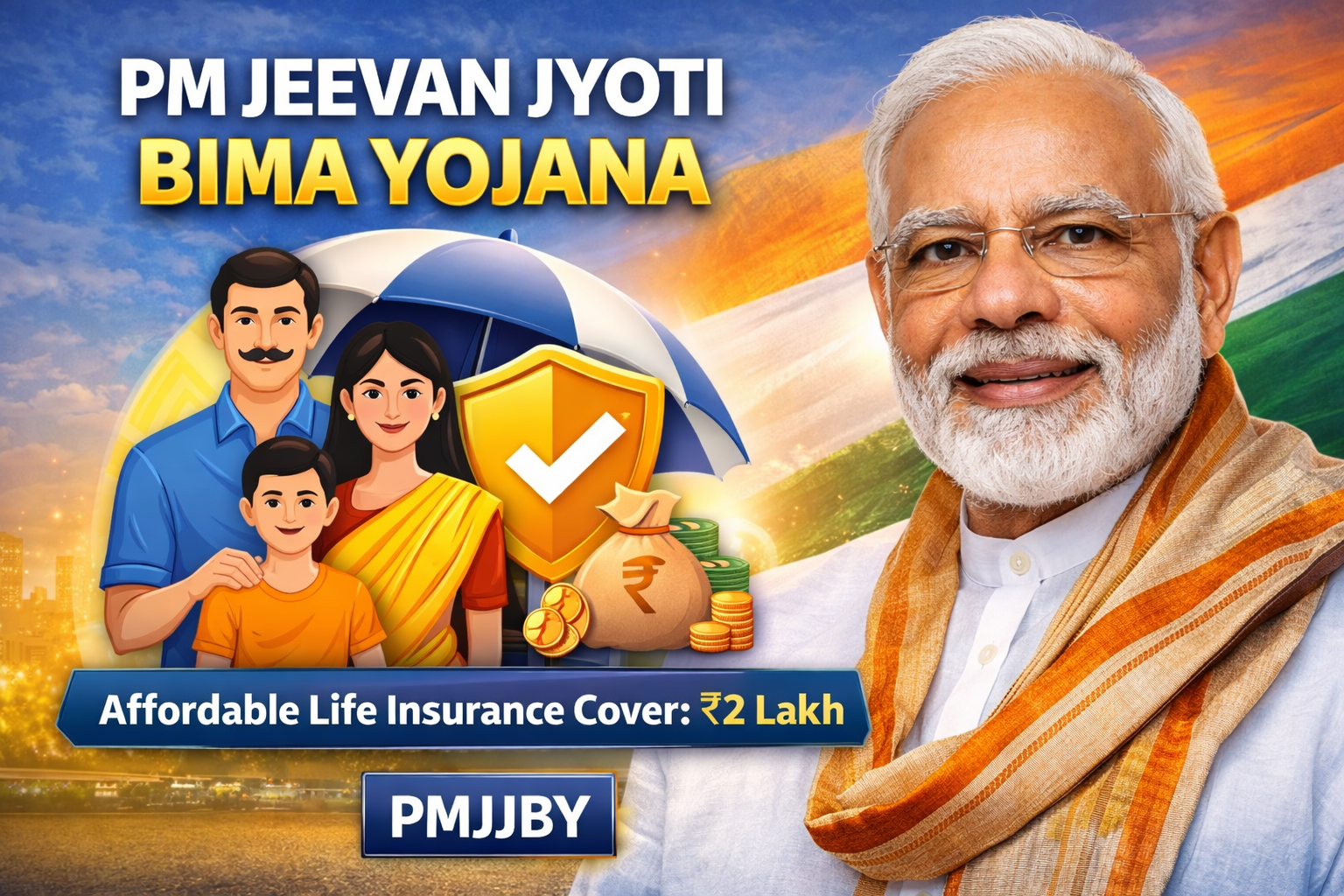
To solve this problem, the Government of India launched PM Jeevan Jyoti Bima Yojana on 9th May 2015. The scheme provides life insurance cover of ₹2 lakh in case of the death of the insured person, in return for a very small annual premium. It is linked with the banking system and works through simple auto-debit from the policyholder’s bank account.
PMJJBY is part of a larger group of social security schemes that also includes:
- Pradhan Mantri Suraksha Bima Yojana (PMSBY) – Accident Insurance
- Atal Pension Yojana (APY) – Pension Scheme
- Pradhan Mantri Jan Dhan Yojana (PMJDY) – Financial Inclusion
Together, these schemes aim to create a basic social security safety net for every Indian citizen.
2. Meaning of PM Jeevan Jyoti Bima Yojana
Let us understand the name:
- Pradhan Mantri = Prime Minister
- Jeevan = Life
- Jyoti = Light
- Bima = Insurance
- Yojana = Scheme
So, Pradhan Mantri Jeevan Jyoti Bima Yojana means:
A life insurance scheme launched by the Prime Minister to provide financial security and “light” (hope) in people’s lives.
In simple words, PMJJBY is a government-backed, low-cost life insurance scheme that gives financial protection to the family of the insured person in case of death.
3. Background: Why Was PMJJBY Needed?
3.1 Low Insurance Penetration in India
Before 2015, India had a serious problem of low insurance coverage:
- A large percentage of the population had no life insurance
- Most poor and informal sector workers were uninsured
- People depended mainly on savings, relatives, or moneylenders during crises
- Many families fell into poverty after the death of the earning member
Although private and public insurance companies existed, their policies were often:
- Too expensive for poor families
- Too complicated to understand
- Difficult to access in rural and remote areas
As a result, life insurance remained limited mainly to urban, salaried, and middle/upper-income groups.
3.2 Financial Vulnerability of Poor Families
In India, a very large number of people work in:
- Agriculture
- Daily wage labor
- Small shops and informal businesses
- Construction and unorganized sectors
These people usually:
- Do not have fixed monthly salaries
- Do not have job security
- Do not have employer-provided insurance
If such a person dies suddenly, the family may:
- Lose its only source of income
- Be unable to pay for food, rent, or education
- Fall into debt or poverty
So, the government felt a strong need to provide a simple, cheap, and universal life insurance cover for such families.
3.3 Government’s Vision of Social Security
After 2014, the Government of India focused strongly on:
- Financial inclusion
- Direct benefit transfer
- Social security for the poor
Schemes like:
- Jan Dhan Yojana (bank accounts for all)
- PMSBY (accident insurance)
- PMJJBY (life insurance)
- Atal Pension Yojana (pension)
…were designed to work together to create a basic protection system for every citizen.
PMJJBY specifically addressed the life insurance gap in India.
4. Launch of PM Jeevan Jyoti Bima Yojana
4.1 Date of Launch
PM Jeevan Jyoti Bima Yojana was officially launched on 9th May 2015 by the Prime Minister of India.
4.2 Place and Occasion
The scheme was launched along with two other major social security schemes:
- Pradhan Mantri Suraksha Bima Yojana (PMSBY)
- Atal Pension Yojana (APY)
The launch marked the beginning of a new era of mass social security coverage in India.
5. Main Objectives of PMJJBY
The main objectives of PM Jeevan Jyoti Bima Yojana are:
- To provide affordable life insurance
- Ensure that even the poorest citizens can afford life insurance.
- To increase insurance coverage in India
- Bring crores of uninsured people under life insurance protection.
- To provide financial security to families
- In case of death of the insured person, the family gets financial support.
- To promote a culture of insurance and risk protection
- Encourage people to think about long-term security, not just daily needs.
- To support inclusive growth and social welfare
- Reduce financial vulnerability and poverty caused by sudden death.
6. Key Features of PM Jeevan Jyoti Bima Yojana
6.1 Type of Scheme
- PMJJBY is a one-year term life insurance scheme
- It is renewable every year
- It is offered through banks and post offices in association with life insurance companies
6.2 Eligibility
To join PMJJBY:
- The person must be between 18 and 50 years of age
- The person must have a savings bank account
- The person must give consent for auto-debit of premium from the bank account
Once enrolled, the person can continue the scheme up to the age of 55 years, subject to regular premium payment.
6.3 Insurance Coverage
- The scheme provides a life insurance cover of ₹2,00,000 (₹2 lakh)
- This amount is paid to the nominee in case of the death of the insured person (due to any reason)
This means:
- Whether the death is due to illness, accident, or natural causes, the cover applies
- It is a pure life insurance scheme (not savings or investment)
6.4 Premium Amount
One of the biggest attractions of PMJJBY is its very low premium:
- The annual premium is ₹436 per year (earlier it was ₹330, later revised)
- The premium is auto-debited from the bank account
So, for just a little more than ₹1 per day, a person gets ₹2 lakh life insurance cover.
6.5 Mode of Payment
- The premium is automatically deducted from the subscriber’s bank account
- This usually happens once a year
- This system ensures:
- No need to remember payment dates
- Less chance of policy lapse due to forgetting payment
6.6 Nomination Facility
- The subscriber must nominate a person (usually a family member)
- In case of death of the insured person, the insurance amount is paid to the nominee
This ensures that the benefit directly reaches the family without complications.
7. How PMJJBY Works
The working of PMJJBY is simple:
- A person opens or already has a bank account
- The person fills a simple enrollment form for PMJJBY
- The person gives consent for auto-debit of premium
- Every year, the bank deducts the premium automatically
- The person remains insured as long as the premium is paid
- In case of death, the nominee files a claim
- After verification, the insurance company pays ₹2 lakh to the nominee
The bank acts as a bridge between the customer and the insurance company.
8. Role of Banks and Insurance Companies
8.1 Role of Banks
Banks play a very important role in PMJJBY:
- Enrolling customers into the scheme
- Collecting premium through auto-debit
- Maintaining records
- Helping nominees with claim process
- Creating awareness among customers
Because PMJJBY is linked to bank accounts, it becomes easy to reach even rural and poor customers.
8.2 Role of Insurance Companies
Life insurance companies:
- Provide the actual insurance cover
- Handle claims and claim settlements
- Work in partnership with banks and the government
- Ensure that the scheme runs smoothly and reliably
Major public and private insurers participate in this scheme under government guidelines.
9. Importance of PMJJBY for Common People
PMJJBY is extremely important for:
- Daily wage workers
- Farmers
- Small shopkeepers
- Drivers, helpers, laborers
- Low-income salaried workers
- Rural and semi-urban families
For these groups:
- Even ₹2 lakh can make a huge difference in difficult times
- It can help pay:
- Household expenses
- Children’s education
- Outstanding loans
- Medical or funeral costs
So, PMJJBY acts as a basic financial safety net.
10. PMJJBY as Part of India’s Social Security System
PMJJBY does not work alone. It is part of a bigger system:
- Jan Dhan Yojana → Bank account for all
- PMJJBY → Life insurance
- PMSBY → Accident insurance
- Atal Pension Yojana → Pension in old age
Together, these schemes aim to cover:
- Life risk (PMJJBY)
- Accident risk (PMSBY)
- Old age risk (APY)
- Financial access (PMJDY)
This creates a basic but powerful social security shield for ordinary Indians.
11. Conclusion of Part 1
PM Jeevan Jyoti Bima Yojana is a historic and people-centric scheme that tries to solve one of India’s biggest problems: lack of life insurance among the poor and vulnerable. With a very small premium, it offers meaningful financial protection to millions of families.
It is simple, affordable, easy to join, and directly linked to the banking system—making it one of the most practical and impactful social security schemes in India.
12. Detailed Eligibility Conditions
To ensure that the scheme remains simple, affordable, and accessible to a large population, the Government of India has kept the eligibility conditions of PMJJBY very straightforward.
12.1 Age Limit
- The minimum age to join PMJJBY is 18 years.
- The maximum age to join is 50 years.
- Once enrolled, the subscriber can continue the scheme up to the age of 55 years, provided the premium is paid regularly.
This means that a person who joins at 18 can get coverage for many years, while someone who joins at 50 can still get coverage up to 55.
12.2 Bank Account Requirement
- The subscriber must have a savings bank account with a bank or post office.
- The scheme works on an auto-debit basis, so having an active account is compulsory.
- The premium is automatically deducted from the account once every year.
This condition also helps in strengthening financial inclusion, as people are encouraged to maintain bank accounts.
12.3 Consent for Auto-Debit
- The subscriber must give written or digital consent to the bank for auto-debit of the premium.
- Without this consent, the bank cannot deduct the premium, and the person cannot remain covered under the scheme.
This makes the process simple and ensures there is no confusion about payments.
12.4 One Person, One Account, One Policy
- A person can enroll in PMJJBY only once.
- Even if a person has multiple bank accounts, only one PMJJBY policy is allowed.
- This rule prevents misuse of the scheme and ensures fair distribution of benefits.
13. Enrollment Process: Step-by-Step
The enrollment process for PMJJBY is designed to be very simple, so that even people with low literacy or limited access to technology can join.
13.1 Offline Enrollment at Bank or Post Office
A person can visit:
- Their bank branch, or
- A post office (if the account is in a post office savings bank)
Steps:
- Ask for the PMJJBY enrollment form.
- Fill in basic details:
- Name
- Date of birth
- Bank account number
- Nominee details
- Sign the consent form for auto-debit of premium.
- Submit the form to the bank/post office.
- The bank will process the request and enroll the person in the scheme.
13.2 Online / Digital Enrollment
Many banks also allow:
- Enrollment through internet banking
- Enrollment through mobile banking apps
- Enrollment through bank’s customer service portals
In this case:
- The customer selects PMJJBY
- Confirms the details
- Gives digital consent for auto-debit
- The policy gets activated electronically
13.3 Confirmation of Enrollment
After successful enrollment:
- The bank or insurance company sends a confirmation message or email
- The subscriber’s account is tagged for annual premium auto-debit
- The life insurance cover becomes active as per the scheme rules
14. Premium Payment System
14.1 Amount of Premium
- The current premium for PMJJBY is ₹436 per year
- This amount is fixed by the government and reviewed from time to time
- Earlier, the premium was ₹330 per year, which was later revised
Even at ₹436 per year, the cost is extremely low compared to normal life insurance policies.
14.2 Mode of Payment
- The premium is paid only through auto-debit from the bank account
- There is no cash payment system
- The bank automatically deducts the amount once every year
This system:
- Reduces the risk of forgetting to pay
- Prevents policy lapse due to missed payments
- Makes administration easier and more transparent
14.3 When Is the Premium Deducted?
- The premium is usually deducted once every year
- The coverage period generally runs from 1st June to 31st May
- If the account does not have sufficient balance, the premium cannot be deducted, and the policy may lapse
So, it is important for the subscriber to keep enough balance in the bank account around the deduction time.
15. Coverage Period and Renewal
15.1 One-Year Term Policy
- PMJJBY is a one-year term life insurance policy
- It must be renewed every year
- Renewal is done automatically if the premium is successfully debited
15.2 Automatic Renewal
- As long as:
- The subscriber is within the eligible age limit, and
- The bank account has sufficient balance for premium
- The policy continues without any break
This automatic renewal system ensures continuous coverage without extra paperwork.
15.3 Lapse and Rejoining
- If the premium is not deducted due to insufficient balance or any other reason:
- The policy lapses
- In some cases, the person may be allowed to rejoin the scheme by paying the premium and fulfilling conditions set by the bank/insurer
However, it is always better to avoid lapse and keep the policy active continuously.
16. Claim Process Under PMJJBY
The claim process is one of the most important parts of any insurance scheme. PMJJBY tries to keep this process simple and user-friendly.
16.1 When Can a Claim Be Made?
A claim can be made when:
- The insured person dies (due to any cause)
- The death occurs during the valid coverage period
- The policy was active at the time of death
16.2 Who Can File the Claim?
- The nominee mentioned in the policy can file the claim
- If there is no nominee, the legal heir can file the claim, as per rules
16.3 Where to File the Claim?
The claim is usually filed at:
- The bank branch where the insured person had the account, or
- The concerned insurance company office, as guided by the bank
In most cases, the bank helps the family in completing the process.
16.4 Documents Required for Claim
Generally, the following documents are required:
- Duly filled claim form
- Death certificate of the insured person
- Bank account details of the nominee
- Identity proof of the nominee
- Any other document required by the bank/insurer
16.5 Claim Settlement Process
- The nominee submits the documents to the bank/insurer
- The documents are verified
- If everything is in order, the claim is approved
- The insurance amount of ₹2,00,000 is transferred to the nominee’s bank account
The aim of the scheme is to ensure fast and hassle-free settlement so that the family gets help quickly.
17. Benefits and Advantages of PMJJBY
PMJJBY offers many important benefits, especially for poor and middle-class families.
17.1 Extremely Low Cost
- For just ₹436 per year, a person gets ₹2 lakh life insurance cover
- This is much cheaper than most private life insurance policies
17.2 Simple and Easy to Join
- No medical tests in most cases
- Simple form and easy process
- Can be joined through banks and post offices
17.3 Wide Reach
- Available across India
- Accessible even in rural and semi-urban areas
- Linked with bank accounts, which are now widespread due to Jan Dhan Yojana
17.4 Financial Security for Family
- In case of death, the family gets ₹2 lakh
- This amount can help in:
- Daily expenses
- Children’s education
- Loan repayment
- Emergency needs
17.5 Supports Social Security Goals
- Helps reduce financial vulnerability
- Complements other schemes like PMSBY and APY
- Strengthens the idea of basic social protection for all
18. Limitations and Criticisms of PMJJBY
Like any scheme, PMJJBY also has some limitations.
18.1 Limited Coverage Amount
- The cover is ₹2 lakh, which may not be sufficient for some families, especially in urban areas with high living costs.
18.2 Age Restriction
- People above 50 years cannot newly join the scheme
- This leaves out many older people who may also need life insurance
18.3 Awareness Issues
- Many eligible people are still not aware of the scheme
- Some people enroll but do not fully understand the benefits or conditions
18.4 Dormant Accounts and Lapse
- If the bank account has no balance, the premium may not be deducted
- This leads to policy lapse without the person realizing it
19. Comparison with Other Insurance Schemes
19.1 PMJJBY vs PMSBY
- PMJJBY: Life insurance (death due to any reason)
- PMSBY: Accident insurance (death or disability due to accident only)
- Both have:
- Low premium
- Simple process
- Government support
Together, they provide broader protection.
19.2 PMJJBY vs Private Life Insurance
- PMJJBY:
- Very low premium
- Fixed cover of ₹2 lakh
- Simple and standardized
- Private insurance:
- Higher premium
- Flexible cover amounts
- More features but more complexity
PMJJBY is best for basic protection, while private insurance can be used for additional cover.
20. Conclusion of Part 2
PM Jeevan Jyoti Bima Yojana stands out as a simple, affordable, and powerful tool for providing life insurance to millions of Indians who were earlier outside the insurance system. Its easy enrollment, low premium, and direct link with bank accounts make it highly practical and effective.
21. Funding Structure and Government Support
21.1 How PMJJBY Is Financed
PMJJBY follows a public–private partnership model:
- The policyholders pay a small annual premium.
- The government provides policy support, standardization, and administrative coordination.
- The insurance companies (public and private) underwrite the risk and settle claims.
- The banks and post offices act as distribution and service channels.
The premium amount is fixed at a level that is affordable for common people while still being actuarially viable for insurers. Because the scheme covers a very large pool of people, the risk gets spread across millions of subscribers, which helps keep the premium low.
21.2 Role of the Government of India
The government does not pay the premium for most subscribers, but it plays a crucial enabling role:
- Designing the scheme and setting uniform rules
- Coordinating between banks and insurance companies
- Creating awareness through national campaigns
- Ensuring transparency and standardization
- Monitoring performance and coverage expansion
In some special cases or state-level initiatives, governments may support awareness drives or enrollment campaigns, but the core strength of PMJJBY lies in its self-sustaining, low-cost model.
22. Institutional Framework and Administration
22.1 Role of the Ministry of Finance
The Ministry of Finance, Government of India is the nodal authority for PMJJBY. It:
- Frames policy guidelines
- Reviews performance regularly
- Coordinates with regulators like IRDAI (Insurance Regulatory and Development Authority of India)
- Ensures alignment with broader financial inclusion and social security goals
22.2 Role of IRDAI
The Insurance Regulatory and Development Authority of India (IRDAI):
- Regulates insurance companies participating in the scheme
- Ensures that claim settlement norms are followed
- Protects the interests of policyholders
- Maintains discipline and transparency in operations
22.3 Role of Banks and Post Offices
Banks and post offices are the frontline institutions of PMJJBY. They:
- Enroll customers
- Collect premium via auto-debit
- Maintain subscriber records
- Help nominees in claim filing
- Act as the first point of contact for beneficiaries
Because India has a huge banking and post office network, PMJJBY is able to reach even remote villages and small towns.
23. Performance and Growth of PMJJBY Over the Years
23.1 Expansion of Coverage
Since its launch in 2015, PMJJBY has:
- Enrolled crores of subscribers across the country
- Brought life insurance to people who never had any cover before
- Become one of the largest government-supported life insurance schemes in the world in terms of number of policies
The scheme especially saw strong participation from:
- Rural areas
- Semi-urban regions
- Low-income and informal sector workers
23.2 Increasing Awareness
Over the years:
- Banks started actively promoting the scheme during account opening
- Government campaigns increased public awareness
- Linkage with Jan Dhan accounts made enrollment easier and faster
As a result, PMJJBY gradually became a well-known name among common people, especially those already connected to the banking system.
23.3 Claim Settlement Experience
One of the important indicators of success for any insurance scheme is claim settlement. PMJJBY has generally shown:
- A simple and standardized claim process
- Faster settlement compared to many traditional policies
- Direct transfer of claim amount to the nominee’s bank account
This has increased trust in the scheme among the public.
24. Role of PMJJBY in Poverty Reduction and Social Security
24.1 Breaking the Cycle of Poverty
For poor families, the death of the earning member often leads to:
- Loss of regular income
- Sale of assets
- Borrowing at high interest
- Children dropping out of school
- Long-term poverty
By providing ₹2 lakh to the family in such situations, PMJJBY helps:
- Manage immediate expenses
- Repay urgent debts
- Support children’s education for some time
- Prevent complete financial collapse
So, while ₹2 lakh may not make a family rich, it can protect them from falling into extreme poverty.
24.2 Strengthening Social Security for Informal Workers
India has a huge informal workforce:
- Construction workers
- Street vendors
- Small farmers
- Domestic workers
- Drivers and helpers
- Daily wage laborers
Most of them:
- Do not have employer-provided insurance
- Do not have pension or job security
- Are highly vulnerable to financial shocks
PMJJBY provides them with at least basic life insurance protection, which is a big step towards inclusive social security.
25. PMJJBY and Financial Inclusion
25.1 Link with Jan Dhan Yojana
PMJJBY works very closely with Pradhan Mantri Jan Dhan Yojana (PMJDY):
- Jan Dhan provides bank accounts
- PMJJBY uses these accounts to provide life insurance
- Together, they ensure:
- Financial access
- Risk protection
- Direct benefit transfer
This combination strengthens the idea that financial inclusion is not just about opening accounts, but also about providing useful financial services.
25.2 Encouraging Banking Habits
Because the premium is auto-debited:
- People are encouraged to keep their bank accounts active
- They maintain some minimum balance
- They become more familiar with banking services
Over time, this helps in building a banking culture among people who earlier depended only on cash.
26. Case Studies and Real-Life Impact (Illustrative Examples)
26.1 A Rural Farmer’s Family
Imagine a small farmer who:
- Earns just enough to support his family
- Has no savings and no insurance
- Enrolls in PMJJBY through his bank
If he dies suddenly due to illness:
- His family receives ₹2 lakh
- This money can be used to:
- Pay off small loans
- Buy seeds or tools
- Support children’s education
- Cover household expenses for some months
Without PMJJBY, the family might have been forced to sell land or borrow from moneylenders.
26.2 A Daily Wage Worker in a City
A construction worker in a city:
- Lives on daily wages
- Has a Jan Dhan account
- Enrolls in PMJJBY with a small premium
In case of his death in an accident or due to illness:
- His wife or nominee gets ₹2 lakh
- This amount can help:
- Pay rent
- Send children back to their village
- Manage basic needs during transition
This shows how even a small insurance cover can bring big relief in crisis.
27. Role of PMJJBY During National Crises (Including COVID-19 Period)
27.1 Importance During Health and Economic Crises
During crises like the COVID-19 pandemic:
- Many families lost their earning members
- Income sources were disrupted
- Medical and living expenses increased
In such times, schemes like PMJJBY:
- Provided financial support to affected families
- Helped in managing sudden shocks
- Proved the importance of having insurance protection
27.2 Strengthening the DBT and Banking Ecosystem
Because PMJJBY is linked to bank accounts:
- Claim amounts could be directly transferred
- There was less paperwork and fewer delays
- The system showed how digital and banking infrastructure can support welfare delivery even in emergencies
28. Future Scope and Possible Reforms
28.1 Increasing Coverage Amount
One possible improvement could be:
- Increasing the life cover from ₹2 lakh to a higher amount
- This would provide better protection, especially in urban areas
However, this would also require:
- Review of premium
- Careful balancing of affordability and sustainability
28.2 Expanding Age Limits
Another possible reform could be:
- Allowing people above 50 years to newly join the scheme
- This would help cover older workers who are still economically active
28.3 Improving Awareness and Financial Literacy
The government and banks can:
- Conduct more awareness campaigns
- Use local languages and community programs
- Educate people about:
- Importance of insurance
- Keeping accounts active
- Nomination and claim process
This would increase effective usage, not just enrollment numbers.
29. Overall Evaluation of PMJJBY
PMJJBY can be evaluated as:
Strengths:
- Very low premium
- Simple structure
- Wide reach through banks and post offices
- Strong support to poor and vulnerable families
- Important pillar of India’s social security system
Weaknesses:
- Limited coverage amount
- Age restrictions
- Dependence on account balance for renewal
- Need for more awareness and financial education
Even with these limitations, PMJJBY remains a highly impactful and socially useful scheme.
30. Conclusion (Towards Final Summary)
PM Jeevan Jyoti Bima Yojana represents a major step forward in India’s journey towards inclusive social security. It recognizes a simple truth: even the poorest families deserve basic financial protection against life’s uncertainties.
By offering a ₹2 lakh life cover at a very low cost, using the banking system as a delivery channel, and keeping the process simple and transparent, PMJJBY has brought life insurance within reach of millions who were earlier excluded.