 Ghar Se Padhai
1. Introduction
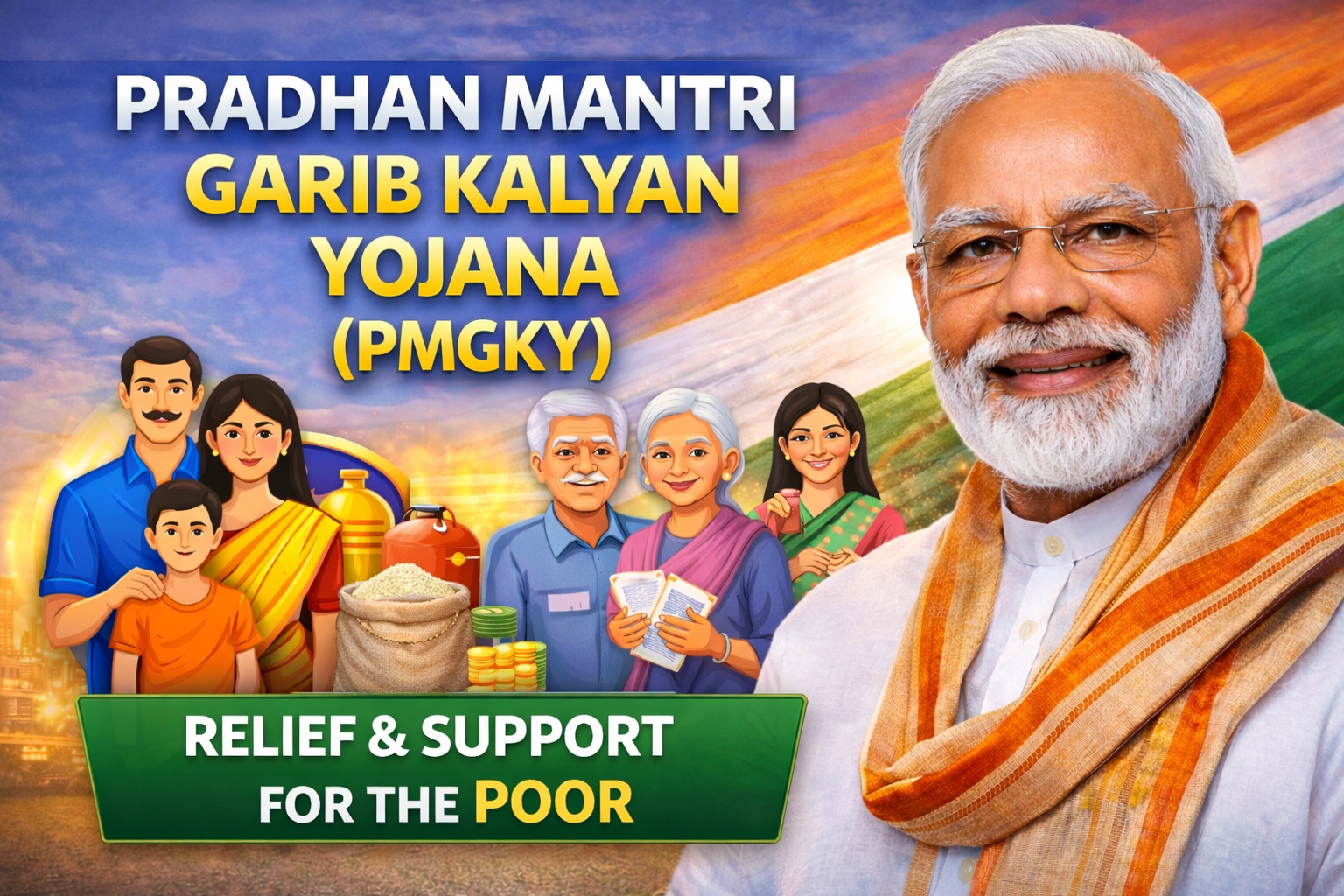
The Pradhan Mantri Garib Kalyan Yojana (PMGKY) is one of the most significant welfare initiatives launched by the Government of India to provide social and economic support to the poor and vulnerable sections of society. The term “Garib Kalyan” literally means “welfare of the poor”, and this scheme reflects the government’s commitment to inclusive growth, social justice, and protection of the weakest sections of the population.
PMGKY gained nationwide attention especially during the COVID-19 pandemic, when millions of people lost jobs, income sources, and livelihoods due to lockdowns and economic slowdown. Migrant workers, daily wage laborers, small farmers, street vendors, and informal sector workers were among the worst affected. In such a crisis, the government needed a large, fast, and direct relief package to ensure that no poor person goes hungry and no vulnerable family is left without basic support.
To address this urgent need, the Government of India announced the Pradhan Mantri Garib Kalyan Yojana as a comprehensive relief and welfare package. The scheme aimed to provide free food grains, cash transfers, cooking gas, and social security benefits to crores of poor families across the country. It was designed to work mainly through the Direct Benefit Transfer (DBT) system and existing welfare databases like Jan Dhan, Aadhaar, and ration cards, so that help could reach people quickly, transparently, and without middlemen.
Over time, the name PMGKY has also been used for other pro-poor welfare measures, including food security extensions and special relief packages. However, its core spirit remains the same: protecting the poor from hunger, poverty, and extreme hardship during times of crisis.
2. Meaning and Concept of PM Garib Kalyan Yojana
Let us understand the name:
- Pradhan Mantri = Prime Minister
- Garib = Poor
- Kalyan = Welfare
- Yojana = Scheme
So, Pradhan Mantri Garib Kalyan Yojana means a Prime Minister-led scheme for the welfare of the poor.
In simple words:
PMGKY is a government welfare scheme/package designed to provide food security, financial support, and social protection to poor and vulnerable people, especially during times of crisis.
The scheme is not limited to just one benefit. Instead, it is a bundle of measures that together aim to ensure:
- No one sleeps hungry
- The poorest families get some cash support
- Essential needs like food and cooking gas are available
- Vulnerable groups like women, farmers, senior citizens, and workers are protected
3. Background: Why Was PMGKY Needed?
3.1 Economic Inequality and Poverty in India
India, despite being one of the fastest-growing economies, still has:
- A large poor population
- Millions of people working in the informal sector
- Many families living hand-to-mouth, depending on daily income
A sudden shock—like a pandemic, natural disaster, or economic slowdown—can push these families into extreme distress.
3.2 Impact of COVID-19 Pandemic
The COVID-19 pandemic created an unprecedented crisis:
- Lockdowns stopped economic activity
- Millions of workers lost jobs or wages
- Migrant workers were stranded without income
- Small businesses shut down
- Poor families struggled to buy food and essentials
In such a situation, the government needed an emergency relief package to:
- Provide food to the hungry
- Put some money in the hands of the poor
- Protect the most vulnerable sections of society
This led to the announcement and expansion of Pradhan Mantri Garib Kalyan Yojana.
3.3 Use of Existing Welfare Infrastructure
India already had:
- Jan Dhan bank accounts
- Aadhaar identification
- Public Distribution System (PDS) for food grains
- DBT system for direct cash transfer
PMGKY was designed to use this existing system to deliver help quickly and efficiently.
4. Objectives of Pradhan Mantri Garib Kalyan Yojana
The main objectives of PMGKY are:
- Ensure food security
- Provide free or subsidized food grains to poor families.
- Provide financial support
- Transfer cash directly to the poor, women, farmers, and vulnerable groups.
- Protect vulnerable sections
- Support senior citizens, widows, disabled persons, and low-income workers.
- Reduce the impact of crisis on the poor
- Prevent hunger, extreme poverty, and social distress during emergencies.
- Strengthen the welfare delivery system
- Use DBT and digital infrastructure for transparent and fast delivery.
5. Key Components of PMGKY
PMGKY is not just one benefit; it is a package of multiple relief measures. The major components include:
5.1 Free Food Grains Under PDS
One of the most important parts of PMGKY is free food grain distribution:
- Eligible families receive:
- 5 kg of rice or wheat per person per month, and
- 1 kg of pulses per family per month (in many phases)
- This is provided free of cost over and above normal PDS entitlement.
- The aim is to ensure no poor person goes hungry during crisis periods.
This component has helped crores of people across India, especially migrant workers and daily wage earners.
5.2 Cash Transfer to Women Jan Dhan Account Holders
To support household expenses:
- Women holding Jan Dhan accounts received direct cash transfers into their bank accounts.
- This money helped families:
- Buy essentials
- Pay small bills
- Manage daily needs during lockdown or crisis
This step also supported women’s financial empowerment.
5.3 Support to Farmers
Farmers are a crucial part of India’s economy, and many small farmers face financial stress. Under PMGKY:
- Cash support was provided to farmers, often through schemes like PM-KISAN, which were aligned with relief measures.
- This helped farmers:
- Buy seeds and inputs
- Manage household expenses
- Continue agricultural activities despite economic difficulties
5.4 Support to Senior Citizens, Widows, and Disabled Persons
PMGKY also focused on socially vulnerable groups:
- Senior citizens
- Widows
- Persons with disabilities
They received additional financial assistance through DBT. For many of them, this was a critical source of support during the crisis.
5.5 Free LPG Cylinders for Poor Households
To ensure that poor families can cook food safely:
- Beneficiaries under the Ujjwala Yojana were provided free LPG cylinders for a certain period.
- This helped:
- Reduce financial burden
- Ensure clean cooking fuel
- Improve health and living conditions
5.6 Social Security for Workers
PMGKY also included measures for:
- Construction workers
- Informal sector workers
Support was provided through:
- Welfare funds
- State government mechanisms
- Direct transfers or assistance programs
The aim was to protect workers who lost jobs or income due to the crisis.
6. Implementation Mechanism
6.1 Role of Direct Benefit Transfer (DBT)
One of the strongest features of PMGKY is its reliance on DBT:
- Money is transferred directly to beneficiaries’ bank accounts
- This:
- Reduces corruption
- Removes middlemen
- Speeds up delivery
- Improves transparency
6.2 Use of Aadhaar and Jan Dhan
The scheme uses the JAM Trinity:
- Jan Dhan (bank accounts)
- Aadhaar (identity)
- Mobile (communication)
This ensures:
- Correct identification of beneficiaries
- Direct transfer of benefits
- Better monitoring and accountability
6.3 Role of Central and State Governments
- The Central Government designs and funds the scheme.
- The State Governments help in:
- Identifying beneficiaries
- Distributing food grains
- Implementing ground-level operations
This cooperative approach improves reach and effectiveness.
7. Achievements and Impact of PMGKY
7.1 Ensuring Food Security
- Crores of people received free food grains.
- This prevented:
- Hunger
- Starvation
- Large-scale food insecurity during crisis periods
7.2 Financial Support to the Poor
- Direct cash transfers helped:
- Poor families manage daily expenses
- Women gain some financial control
- Vulnerable groups survive economic shocks
7.3 Strengthening Welfare Delivery System
PMGKY showed that:
- India’s digital and banking infrastructure can deliver large-scale welfare quickly.
- DBT can be an effective tool for transparent governance.
7.4 Support During a National Crisis
During COVID-19 and other difficult periods, PMGKY acted as a safety net for millions of families, reducing social unrest and human suffering.
8. Challenges and Limitations
Despite its success, PMGKY also faced some challenges:
8.1 Identification Errors
- Some deserving people:
- Did not have ration cards or bank accounts
- Were left out due to documentation issues
8.2 Migrant Worker Issues
- Migrant workers often:
- Were not registered in the place they worked
- Faced difficulties in accessing ration and benefits
8.3 Implementation and Logistics
- Distributing food grains to such a large population is:
- Logistically complex
- Costly
- Dependent on state-level efficiency
8.4 Fiscal Burden
- PMGKY involves huge government spending.
- While necessary during crises, it also:
- Increases fiscal pressure
- Requires careful financial planning for sustainability
9. PMGKY and India’s Social Security System
PMGKY fits into a larger framework of welfare schemes like:
- PM Jan Dhan Yojana
- PM Ujjwala Yojana
- PM Awas Yojana
- PMJJBY and PMSBY (insurance schemes)
- PM-KISAN (farmer income support)
Together, these schemes aim to create a basic social security net for the poor and vulnerable.
10. Long-Term Significance of PMGKY
PMGKY is important not just as a crisis scheme, but also because:
- It shows the importance of food security in a large, diverse country
- It highlights the power of DBT and digital governance
- It strengthens the idea that the state has a responsibility to protect the weakest
- It sets an example for future emergency relief programs
11. Conclusion
The Pradhan Mantri Garib Kalyan Yojana (PMGKY) stands as one of the largest and most ambitious welfare and relief initiatives in India’s history. Designed to protect the poor and vulnerable during times of crisis, it combines food security, financial assistance, and social protection into a single, powerful support system.
By providing free food grains, direct cash transfers, cooking gas support, and help to vulnerable groups, PMGKY helped millions of families survive one of the most difficult periods in recent history. While challenges remain in terms of coverage, implementation, and fiscal cost, the scheme has clearly shown the strength of India’s welfare infrastructure and the importance of inclusive governance.
In essence, PMGKY is not just a scheme—it is a symbol of the government’s commitment to ensure that even in the worst times, the poor are not left alone, hungry, or helpless.