 Ghar Se Padhai
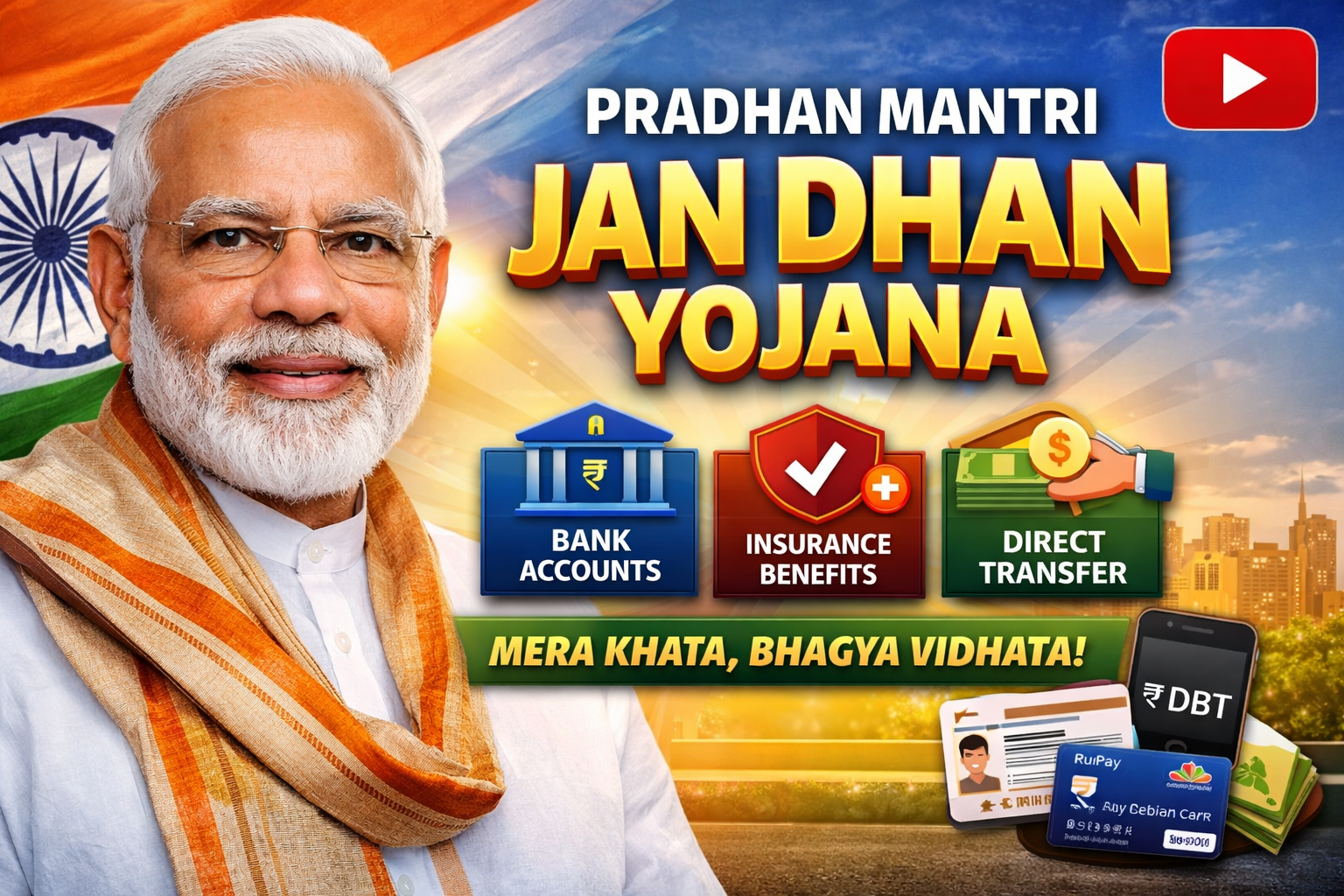
Pradhan Mantri Jan Dhan Yojana (PMJDY) – Launched on 28th August 2014
A Detailed Study of India’s Biggest Financial Inclusion Mission (Part 1)
1. Introduction
On 28th August 2014, the Government of India launched one of the most ambitious financial inclusion programs in the world: the Pradhan Mantri Jan Dhan Yojana (PMJDY), popularly known as the Jan Dhan Yojana. Announced by the Prime Minister of India, Shri Narendra Modi, this scheme aimed to ensure that every household in India has access to banking and financial services.
Before this scheme, a very large section of India’s population—especially in rural areas, small towns, and among the poor—had no access to formal banking. People depended on cash, informal lenders, or unsafe saving methods. This kept millions trapped in poverty, debt, and financial insecurity.
The Jan Dhan Yojana was designed to change this situation by providing:
- A basic savings bank account for every household
- Zero-balance account facility
- RuPay debit card
- Accident insurance cover
- Life insurance cover
- Direct Benefit Transfer (DBT) of government subsidies
- Access to credit, pension, and insurance in the long term
In simple words, PMJDY was not just a bank account scheme—it was a foundation stone for financial empowerment and inclusive growth in India.
2. Meaning of “Jan Dhan Yojana”
The term “Jan Dhan” literally means “People’s Wealth”:
- Jan = People
- Dhan = Wealth/Money
- Yojana = Scheme/Plan
So, Jan Dhan Yojana means a scheme to connect common people with the formal financial system and help them build financial security.
The official name is:
Pradhan Mantri Jan Dhan Yojana (PMJDY)
Its main slogan was:
“Mera Khata, Bhagya Vidhata” (My Account, the Creator of My Fortune)
3. Background: Why Was Jan Dhan Yojana Needed?
3.1 Financial Exclusion in India Before 2014
Before 2014, India had:
- Crores of people without bank accounts
- Heavy dependence on cash transactions
- Poor people saving money at home (unsafe and unproductive)
- Dependence on moneylenders charging very high interest
- Difficulty in receiving government benefits due to lack of bank accounts
- Leakages and corruption in subsidy distribution
Even though banks existed, a large part of the population—especially:
- Farmers
- Daily wage workers
- Migrant laborers
- Small shopkeepers
- Rural women
- Urban poor
…were outside the formal banking system.
3.2 Problems Caused by Lack of Banking Access
Because people had no bank accounts:
- They could not save money safely
- They could not get cheap loans from banks
- They could not get insurance or pension
- Government subsidies were often lost, delayed, or misused
- People stayed stuck in the cycle of poverty
So, financial exclusion was not just a banking problem—it was a development problem.
4. Announcement and Launch of Jan Dhan Yojana
4.1 Announcement
In his Independence Day speech on 15th August 2014, Prime Minister Narendra Modi announced the launch of a massive financial inclusion program.
He said that:
“We want to connect every household of the nation with the banking system.”
4.2 Official Launch Date
The scheme was officially launched on 28th August 2014 across the country.
On that day:
- Special camps were organized by banks
- Millions of people opened accounts in a single day
- The scheme entered the Guinness World Records for opening the highest number of bank accounts in one week
This made PMJDY one of the largest financial inclusion drives in world history.
5. Main Objectives of Jan Dhan Yojana
The core objectives of PMJDY were:
- Universal access to banking facilities
- Ensure that every household has at least one bank account.
- Financial inclusion
- Bring poor and unbanked people into the formal financial system.
- Secure savings
- Encourage people to save money safely in banks.
- Access to credit
- Provide opportunities for small loans and overdraft facilities.
- Direct Benefit Transfer (DBT)
- Transfer government subsidies directly into beneficiaries’ accounts.
- Insurance and pension coverage
- Provide basic social security through insurance and pension schemes.
- Reduce corruption and leakages
- Eliminate middlemen in subsidy distribution.
6. Key Features of Pradhan Mantri Jan Dhan Yojana
6.1 Zero Balance Bank Account
One of the biggest attractions of PMJDY was that:
- People could open a bank account with zero balance
- Even the poorest person could open an account
- No minimum balance was required
This removed the biggest psychological and financial barrier to entering the banking system.
6.2 RuPay Debit Card
Each account holder was given a RuPay debit card, which allowed them to:
- Withdraw money from ATMs
- Make digital payments
- Check balance
- Access basic banking services
This also helped promote digital payments in India.
6.3 Accident Insurance Cover
Under PMJDY, account holders were provided:
- Accident insurance cover of ₹1 lakh (later increased to ₹2 lakh for certain accounts)
This meant:
- If the account holder died or became disabled due to an accident, the family would get financial support.
6.4 Life Insurance Cover
In the initial phase of the scheme:
- A life insurance cover of ₹30,000 was provided to eligible account holders
This gave poor families a basic safety net in case of the death of the earning member.
6.5 Overdraft Facility
After satisfactory operation of the account:
- Account holders could get an overdraft facility (initially up to ₹5,000, later increased to ₹10,000)
This helped:
- Meet emergency needs
- Avoid borrowing from moneylenders
- Build a credit history
6.6 Direct Benefit Transfer (DBT)
One of the most powerful features of PMJDY was:
- Government subsidies and benefits (like LPG subsidy, pensions, scholarships, MGNREGA wages, etc.) could be directly transferred into bank accounts.
This:
- Reduced corruption
- Eliminated middlemen
- Ensured money reached the real beneficiaries
7. Implementation Strategy
7.1 Role of Banks
- Public sector banks, private banks, and regional rural banks participated
- Banks organized special camps in villages and cities
- Simplified KYC (Know Your Customer) norms were used
7.2 Business Correspondents (Bank Mitras)
- In remote areas, Bank Mitras or Business Correspondents were appointed
- They provided banking services in villages where no branch existed
- This helped reach people in far-flung rural areas
8. Early Impact of Jan Dhan Yojana
Within a very short time:
- Crores of accounts were opened
- India moved rapidly towards universal financial inclusion
- Millions of people entered the banking system for the first time
- Government started using these accounts for DBT transfers
The scheme was widely described as a game-changer in India’s development journey.
9. Significance of Jan Dhan Yojana in India’s Development
PMJDY is important because it:
- Strengthened the banking habit among poor people
- Increased financial literacy
- Supported Digital India and DBT reforms
- Helped in poverty reduction
- Laid the foundation for other schemes like:
- UPI and digital payments
- Direct subsidy transfers
- Insurance and pension schemes for the poor
10. Conclusion of Part 1
The Pradhan Mantri Jan Dhan Yojana, launched on 28th August 2014, is not just a government scheme—it is a historic reform that changed the way millions of Indians interact with money, banks, and the state.
It aimed to give every Indian a financial identity, a safe place to save, and a gateway to economic opportunity.