 Ghar Se Padhai
1. Introduction
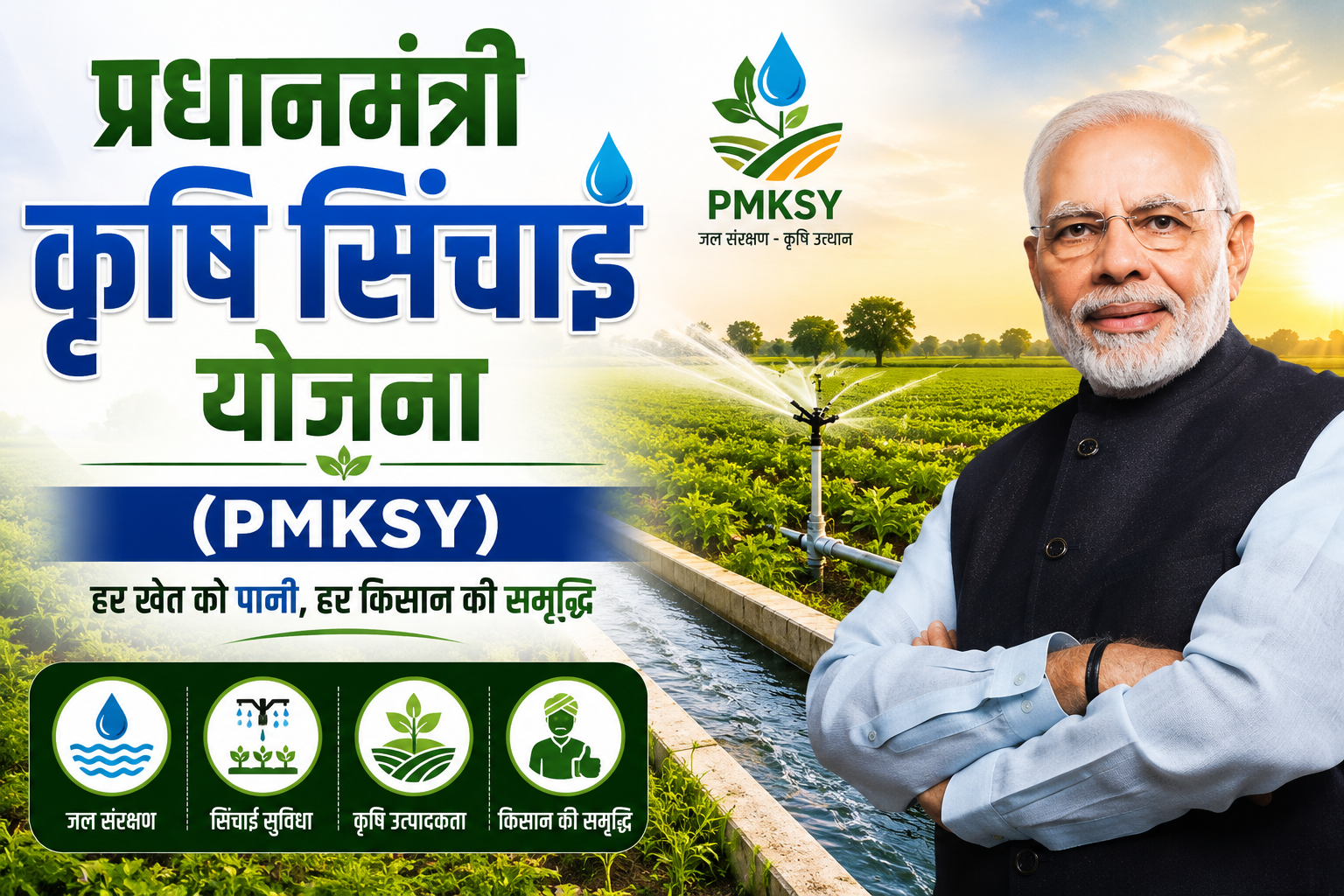
Agriculture is the backbone of the Indian economy. A large percentage of India’s population depends directly or indirectly on farming for their livelihood. However, Indian agriculture has long suffered from problems such as irregular rainfall, water scarcity, poor irrigation facilities, groundwater depletion, and inefficient use of water. To solve these issues and improve agricultural productivity, the Government of India launched the Pradhan Mantri Krishi Sinchai Yojana (PMKSY).
The scheme was launched in 2015 by the Government of India under the leadership of Prime Minister Narendra Modi. The main objective of PMKSY is to provide water to every agricultural field and improve water-use efficiency through modern irrigation methods.
The slogan of the scheme is:
“Har Khet Ko Pani”
(Water to Every Field)
The scheme aims to ensure that farmers across India get proper irrigation facilities so that crop production can increase and farmers’ income can improve.
2. Background of PMKSY
Before PMKSY, irrigation projects in India were handled by different ministries and departments separately. Due to lack of coordination, many irrigation projects remained incomplete for years.
India also faced several agricultural problems:
- Dependence on monsoon rainfall
- Drought conditions in many regions
- Low irrigation coverage
- Wastage of water
- Poor water management systems
To solve these issues in an integrated manner, the Government launched PMKSY by combining various irrigation and water management schemes under one umbrella.
The scheme brought together the efforts of several ministries such as:
- Ministry of Jal Shakti
- Ministry of Agriculture and Farmers Welfare
- Ministry of Rural Development
This integrated approach helped improve coordination and efficiency.
3. Objectives of PMKSY
The Pradhan Mantri Krishi Sinchai Yojana has several important objectives.
1. Expand Irrigation Coverage
The scheme aims to bring more agricultural land under irrigation so that farmers do not depend only on rainfall.
2. Improve Water Use Efficiency
PMKSY promotes efficient use of water through modern irrigation techniques such as:
- Drip irrigation
- Sprinkler irrigation
- Micro-irrigation
3. Reduce Water Wastage
Traditional irrigation methods waste a large amount of water. PMKSY encourages scientific irrigation methods to reduce wastage.
4. Increase Agricultural Productivity
Proper irrigation improves crop growth and increases yield.
5. Promote Sustainable Agriculture
The scheme supports long-term water conservation and sustainable farming practices.
6. Ensure “Per Drop More Crop”
This concept focuses on producing more crops with less water.
4. Major Components of PMKSY
PMKSY has several major components.
A. Accelerated Irrigation Benefits Programme (AIBP)
This component focuses on completing long-pending irrigation projects.
Objectives:
- Speed up incomplete irrigation projects
- Increase irrigation potential
- Improve water availability
Importance:
Many irrigation projects in India were delayed due to lack of funding and coordination. AIBP provides financial support to complete these projects quickly.
B. Har Khet Ko Pani
This component aims to provide irrigation facilities to every agricultural field.
Activities Include:
- Construction of canals
- Water distribution systems
- Repair of traditional water bodies
- Groundwater development
Benefits:
- Better water access
- Increased cultivation area
- Reduced dependence on rainfall
C. Per Drop More Crop
This is one of the most important components of PMKSY.
It promotes:
- Micro-irrigation
- Drip irrigation
- Sprinkler systems
Benefits:
- Saves water
- Reduces labor costs
- Increases crop productivity
- Reduces fertilizer wastage
D. Watershed Development
This component focuses on conserving soil and water resources.
Activities:
- Rainwater harvesting
- Soil conservation
- Plantation programs
- Check dam construction
Importance:
Watershed development helps improve groundwater recharge and prevents soil erosion.
5. Importance of Irrigation in Agriculture
Irrigation is extremely important for agriculture.
1. Reduces Dependence on Rainfall
India’s agriculture depends heavily on monsoon rains. Irrigation ensures stable water supply even during drought.
2. Increases Crop Production
Proper irrigation improves crop growth and yield.
3. Multiple Cropping
Farmers can grow more than one crop in a year if irrigation facilities are available.
4. Improves Farmer Income
Higher crop production leads to better earnings for farmers.
6. Micro-Irrigation under PMKSY
Micro-irrigation is a major focus area under PMKSY.
Types of Micro-Irrigation
1. Drip Irrigation
Water is supplied directly to plant roots drop by drop.
Benefits:
- Saves water
- Reduces weed growth
- Improves crop quality
2. Sprinkler Irrigation
Water is sprayed like rainfall using pipes and sprinklers.
Benefits:
- Suitable for uneven land
- Reduces soil erosion
- Uniform water distribution
7. Financial Assistance under PMKSY
The government provides subsidies to farmers for installing micro-irrigation systems.
Subsidy Benefits
Different states provide different subsidy amounts.
Generally:
- Small and marginal farmers receive higher subsidies.
- Subsidy may cover 55% to 75% of installation cost.
Funding Pattern
The scheme is jointly funded by:
- Central Government
- State Governments
8. Implementation Structure
PMKSY is implemented at multiple levels.
National Level
The scheme is supervised by the Central Government.
State Level
State governments prepare irrigation plans and implement projects.
District Level
District authorities monitor progress and coordinate local activities.
9. Role of Technology in PMKSY
Technology plays an important role in the scheme.
GIS Mapping
Used for planning irrigation projects.
Mobile Applications
Farmers can access scheme information and subsidy details through apps.
Remote Sensing
Helps monitor water usage and crop conditions.
10. Benefits of PMKSY
PMKSY provides many benefits to farmers and the agricultural sector.
A. Benefits to Farmers
1. Increased Crop Yield
Regular irrigation improves crop growth.
2. Reduced Farming Risk
Farmers are less affected by drought.
3. Higher Income
Better production leads to increased earnings.
4. Water Savings
Modern irrigation systems reduce water wastage.
B. Environmental Benefits
1. Groundwater Conservation
Efficient irrigation reduces overuse of groundwater.
2. Soil Conservation
Proper water management prevents soil erosion.
3. Sustainable Agriculture
Promotes long-term environmental protection.
C. Economic Benefits
1. Rural Development
Improved agriculture strengthens rural economy.
2. Employment Generation
Irrigation projects create employment opportunities.
3. Food Security
Higher agricultural production improves food availability.
11. Achievements of PMKSY
Since its launch, PMKSY has achieved several milestones.
1. Expansion of Irrigation Coverage
Millions of hectares of land have been brought under irrigation.
2. Promotion of Micro-Irrigation
Large numbers of farmers have adopted drip and sprinkler systems.
3. Completion of Irrigation Projects
Many long-pending projects have been completed.
4. Water Conservation
Significant reduction in water wastage has been observed.
12. PMKSY and Sustainable Development
PMKSY supports sustainable development goals.
SDG Goals Supported:
- Zero Hunger
- Clean Water and Sanitation
- Climate Action
- Poverty Reduction
The scheme helps ensure environmental sustainability and agricultural growth.
13. Challenges Faced by PMKSY
Despite its success, PMKSY faces several challenges.
1. Lack of Awareness
Many farmers are unaware of modern irrigation techniques.
2. High Initial Cost
Micro-irrigation systems can be expensive for poor farmers.
3. Maintenance Issues
Farmers sometimes face difficulties in maintaining equipment.
4. Water Scarcity
In some regions, water sources are extremely limited.
5. Delays in Project Completion
Some irrigation projects still face delays due to administrative issues.
14. Government Initiatives to Improve PMKSY
The government has taken several measures to improve the scheme.
1. Awareness Campaigns
Training programs educate farmers about water-saving methods.
2. Digital Monitoring
Online systems monitor project progress.
3. Increased Funding
More financial support has been provided for irrigation infrastructure.
4. Farmer Training
Farmers receive technical guidance on modern irrigation systems.
15. PMKSY in Different States
Different states have implemented PMKSY according to local agricultural conditions.
Maharashtra
Focus on drip irrigation for sugarcane farming.
Gujarat
Large-scale micro-irrigation adoption.
Rajasthan
Water conservation in drought-prone areas.
Punjab and Haryana
Efficient irrigation for wheat and rice cultivation.
16. Importance of Water Conservation
India faces serious water challenges.
Reasons:
- Population growth
- Climate change
- Groundwater depletion
PMKSY promotes efficient water use to address these challenges.
The concept of:
“More Crop Per Drop”
encourages farmers to maximize productivity while minimizing water use.
17. PMKSY and Climate Change
Climate change has increased droughts and irregular rainfall.
PMKSY helps farmers adapt by:
- Improving water storage
- Conserving groundwater
- Promoting efficient irrigation
This increases climate resilience in agriculture.
18. Role of Farmers in PMKSY
Farmers play a key role in the success of the scheme.
They are encouraged to:
- Adopt modern irrigation
- Use water responsibly
- Participate in watershed programs
- Maintain irrigation systems properly
Farmer participation improves the effectiveness of the scheme.
19. Future Scope of PMKSY
PMKSY has significant future potential.
Suggested Improvements:
- Expand micro-irrigation coverage
- Increase subsidies
- Improve awareness programs
- Use advanced technologies
- Strengthen water conservation efforts
With proper implementation, PMKSY can transform Indian agriculture.
20. Conclusion
The Pradhan Mantri Krishi Sinchai Yojana is one of the most important agricultural and irrigation schemes launched by the Government of India. It aims to provide water to every field, improve irrigation efficiency, conserve water, and increase agricultural productivity.
Through components such as:
- Har Khet Ko Pani
- Per Drop More Crop
- Watershed Development
- Accelerated Irrigation Benefits Programme
the scheme supports sustainable agriculture and rural development.
PMKSY has helped millions of farmers by improving irrigation facilities, increasing crop yields, and promoting efficient water management. Although challenges remain, continued government support and farmer participation can make the scheme even more successful in the future.
The scheme is a major step toward:
- Water conservation
- Farmer welfare
- Food security
- Sustainable agricultural development in India.