 Ghar Se Padhai
1. Introduction
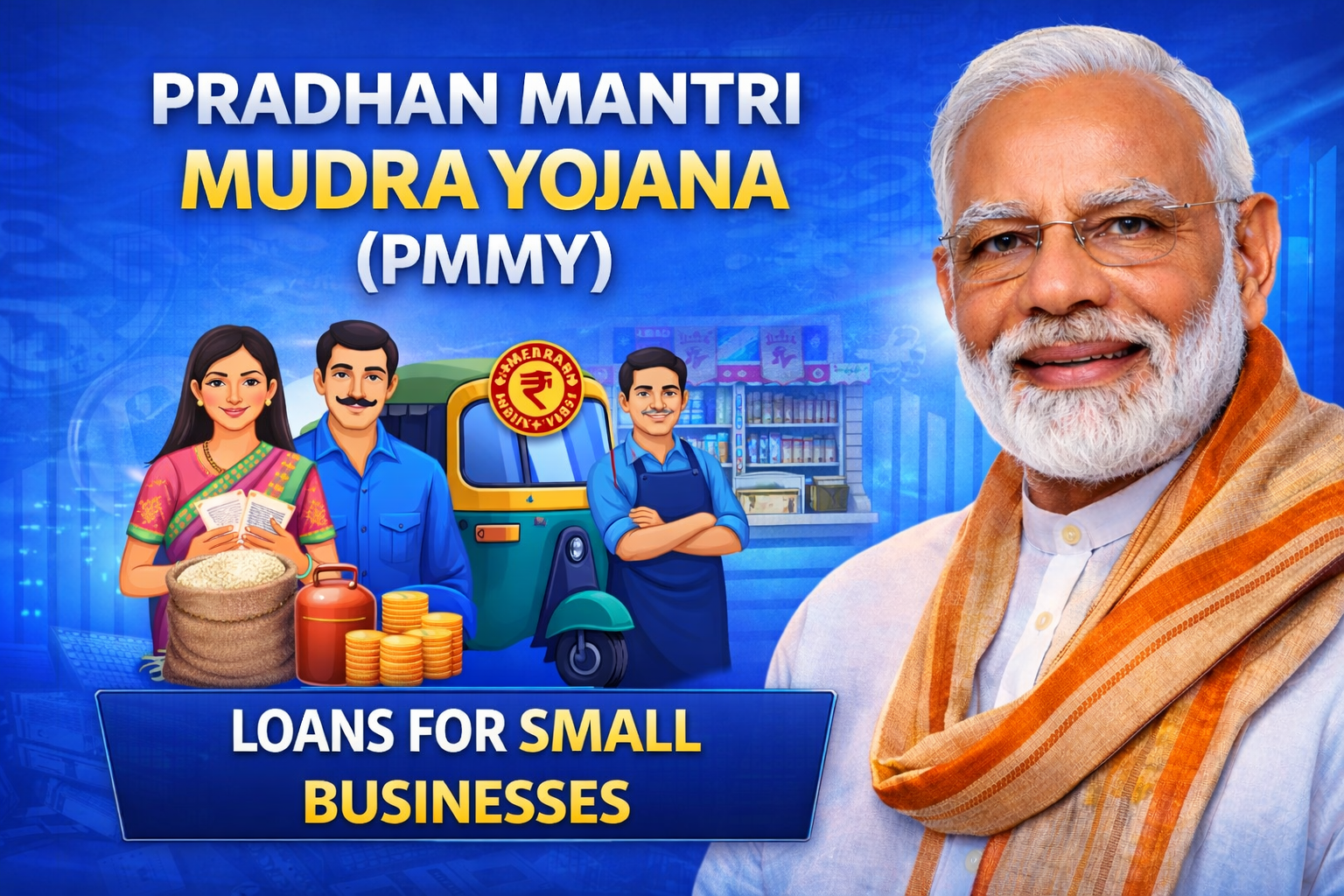
The Pradhan Mantri Mudra Yojana (PMMY) is one of the most important financial inclusion and entrepreneurship promotion schemes launched by the Government of India. The scheme was introduced with the objective of providing easy, affordable, and institutional credit to micro and small entrepreneurs, especially those who were earlier dependent on informal sources of finance such as moneylenders.
In India, a very large part of the economy is driven by micro enterprises, small businesses, and self-employed individuals. These include:
- Street vendors and hawkers
- Small shop owners and kirana stores
- Tailors, barbers, and cobblers
- Small manufacturing units and workshops
- Transport operators and auto drivers
- Home-based businesses and artisans
- Women entrepreneurs and self-help group members
Although these businesses play a crucial role in employment generation and local economic development, they often face one major problem: lack of access to formal credit. Traditional banks usually require:
- Collateral or security
- Complex documentation
- Credit history and formal income proof
Most small entrepreneurs do not have these, so they are forced to borrow from moneylenders at very high interest rates, which keeps them trapped in debt and poverty.
To solve this problem and to encourage self-employment, entrepreneurship, and financial inclusion, the Government of India launched the Pradhan Mantri Mudra Yojana (PMMY) on 8th April 2015. The scheme provides collateral-free loans up to ₹10 lakh to non-corporate, non-farm small business units.
The word MUDRA stands for Micro Units Development and Refinance Agency. Under this scheme, MUDRA acts as a refinancing institution that supports banks and other lending institutions in giving loans to micro-entrepreneurs.
2. Meaning and Concept of MUDRA
The term MUDRA has a dual meaning:
- As an acronym:
- MUDRA = Micro Units Development and Refinance Agency
- In Indian languages, “Mudra” also means symbol or currency, which connects well with the idea of financial support and empowerment.
So, Pradhan Mantri Mudra Yojana can be understood as:
A government-backed scheme that provides easy and collateral-free loans to micro and small entrepreneurs to help them start, expand, and sustain their businesses.
The core idea of PMMY is:
- To bring small entrepreneurs into the formal banking system
- To reduce dependence on moneylenders
- To promote self-employment and job creation
- To support inclusive economic growth
3. Background: Why Was PMMY Needed?
3.1 Importance of Micro and Small Enterprises in India
Micro and small enterprises form the backbone of the Indian economy. They:
- Provide employment to crores of people
- Support local markets and supply chains
- Encourage entrepreneurship and innovation
- Play a major role in poverty reduction and income generation
Despite their importance, these businesses often remain small and informal because they do not get proper financial support.
3.2 The Problem of Credit Gap
Before PMMY:
- Many small entrepreneurs:
- Had no bank accounts or credit history
- Could not provide collateral
- Found bank procedures complicated
As a result:
- They depended on informal lenders
- Paid very high interest rates
- Could not invest in:
- Better equipment
- More stock
- Business expansion
This created a huge credit gap between what small businesses needed and what formal banks provided.
3.3 Need for Financial Inclusion and Entrepreneurship Promotion
After 2014, the Government of India strongly focused on:
- Financial inclusion (Jan Dhan Yojana)
- Digital payments
- Self-employment and startups
- Skill development
PMMY fits perfectly into this vision by:
- Providing institutional credit to the smallest entrepreneurs
- Encouraging people to start their own businesses
- Supporting the idea of “Make in India” and “Startup India” at the grassroots level
4. Launch of Pradhan Mantri Mudra Yojana
- Launch Date: 8th April 2015
- Launched By: Government of India
- Implementing Agency: MUDRA (Micro Units Development and Refinance Agency) under the guidance of the Government of India and RBI
The scheme was launched with the vision:
“Funding the Unfunded” – to provide credit to those who were earlier outside the formal credit system.
5. Objectives of PM Mudra Yojana
The main objectives of PMMY are:
- Provide easy access to credit
- Ensure that small entrepreneurs can get loans without collateral.
- Promote self-employment
- Encourage people to start their own businesses and become job creators.
- Support micro and small enterprises
- Help existing businesses grow and become more stable.
- Reduce dependence on moneylenders
- Bring entrepreneurs into the formal banking system.
- Boost economic growth and employment
- Strengthen the grassroots economy and create more jobs.
6. Key Features of PM Mudra Yojana
6.1 Collateral-Free Loans
- One of the biggest features of PMMY is that:
- Loans are given without any collateral or security.
- This is extremely important for:
- Small shopkeepers
- Street vendors
- Artisans
- Self-employed workers
- They usually do not have property or assets to pledge as security.
6.2 Loan Limit
- Under PMMY, loans can be given up to ₹10 lakh.
- These loans are meant for:
- Non-corporate
- Non-farm
- Small business units
6.3 Three Categories of Loans
To meet the different needs of businesses at different stages, PMMY loans are divided into three categories:
(a) Shishu
- Loan amount: Up to ₹50,000
- Target group:
- Very small and new businesses
- Startups at a very early stage
- Examples:
- A tea stall
- A small tailoring shop
- A street food vendor
(b) Kishor
- Loan amount: ₹50,001 to ₹5,00,000
- Target group:
- Businesses that are already running
- Need funds for expansion or improvement
- Examples:
- A small retail shop wanting to buy more stock
- A workshop needing new tools
(c) Tarun
- Loan amount: ₹5,00,001 to ₹10,00,000
- Target group:
- Well-established small businesses
- Looking for bigger expansion
- Examples:
- A small manufacturing unit
- A transport business adding more vehicles
This structure ensures that every stage of business growth is supported.
6.4 Who Provides Mudra Loans?
Mudra loans are provided by:
- Public sector banks
- Private sector banks
- Regional Rural Banks (RRBs)
- Cooperative banks
- Microfinance institutions (MFIs)
- Non-Banking Financial Companies (NBFCs)
MUDRA (the agency) itself does not give loans directly to the public. Instead, it:
- Provides refinance to these institutions
- Supports and guides them in lending to micro enterprises
7. Eligibility for PM Mudra Yojana
A person or business can apply for a Mudra loan if:
- They are an Indian citizen
- They run a non-farm, non-corporate small business
- The business is involved in:
- Manufacturing
- Trading
- Services
- The loan requirement is up to ₹10 lakh
Eligible borrowers include:
- Shopkeepers
- Vendors
- Artisans
- Small manufacturers
- Service providers
- Self-employed professionals at a small scale
- Women entrepreneurs
- Members of self-help groups (SHGs)
8. Types of Activities Covered Under PMMY
PMMY supports a wide range of activities, such as:
- Manufacturing:
- Small workshops
- Handicrafts
- Food processing units
- Trading:
- Retail shops
- Wholesale traders
- Street vendors
- Services:
- Beauty parlours
- Repair shops
- Transport services
- Tailoring and stitching units
- Photocopy and printing shops
This wide coverage makes PMMY very flexible and inclusive.
9. Application Process for Mudra Loan
9.1 Where to Apply?
A person can apply for a Mudra loan at:
- Any bank branch
- Any participating NBFC or MFI
- Through online portals of banks
- Through the Mudra or government-linked portals (in many cases)
9.2 Documents Required
Usually, the following documents are required:
- Identity proof (Aadhaar, Voter ID, etc.)
- Address proof
- Business details or plan
- Bank account details
- Passport-size photographs
For small loans, especially under Shishu, the documentation is kept very simple.
9.3 Loan Sanction and Disbursement
- The bank or lending institution:
- Verifies the details
- Assesses the business need
- If satisfied:
- The loan is sanctioned
- The amount is credited to the borrower’s bank account
10. Benefits and Impact of PMMY
10.1 Financial Inclusion
- PMMY has brought crores of small entrepreneurs into the formal banking system.
- Many first-time borrowers have received bank loans for the first time in their lives.
10.2 Promotion of Entrepreneurship
- The scheme encourages:
- Youth
- Women
- Rural and urban poor
- To:
- Start small businesses
- Become self-employed
- Create jobs for others
10.3 Support to Women Entrepreneurs
- A large number of Mudra loans are given to women entrepreneurs.
- This helps in:
- Women’s economic empowerment
- Improving family income
- Strengthening social status of women
10.4 Reduction in Dependence on Moneylenders
- By providing easy bank credit, PMMY:
- Reduces exploitation by moneylenders
- Lowers the burden of high-interest loans
- Improves financial stability of small businesses
11. Challenges and Criticisms
Despite its success, PMMY also faces some challenges:
11.1 Risk of Loan Defaults
- Some borrowers:
- May not use the loan properly
- May fail to repay due to business failure
- This increases the Non-Performing Assets (NPAs) of banks.
11.2 Quality of Credit and Monitoring
- Giving loans to a very large number of small borrowers requires:
- Proper monitoring
- Financial literacy
- Business guidance
Without this, some businesses may struggle to succeed.
11.3 Need for Skill and Market Support
- Credit alone is not enough.
- Small entrepreneurs also need:
- Skills
- Training
- Market access
- Without these, the full potential of PMMY cannot be achieved.
12. Overall Significance of PM Mudra Yojana
PMMY is more than just a loan scheme. It is:
- A tool for economic empowerment
- A support system for grassroots entrepreneurship
- A pillar of inclusive growth
- A step towards self-reliant India (Atmanirbhar Bharat)
By funding the unfunded, PMMY helps turn small dreams into real businesses.
13. Conclusion
The Pradhan Mantri Mudra Yojana (PMMY) has played a transformative role in India’s journey towards financial inclusion and entrepreneurship-driven growth. By providing collateral-free loans to micro and small entrepreneurs, it has opened the doors of formal finance to millions who were earlier excluded from the banking system.
The scheme supports businesses at every stage—from tiny startups under Shishu, to growing enterprises under Kishor, and expanding units under Tarun. It has helped generate employment, promote self-reliance, empower women, and strengthen the grassroots economy.
Although challenges like loan defaults and the need for better business support remain, PMMY stands as a powerful example of how targeted credit policies can change lives and strengthen the nation’s economic foundation. In the long run, schemes like PMMY are essential for building a more inclusive, resilient, and self-reliant India.