 Ghar Se Padhai
1. Introduction
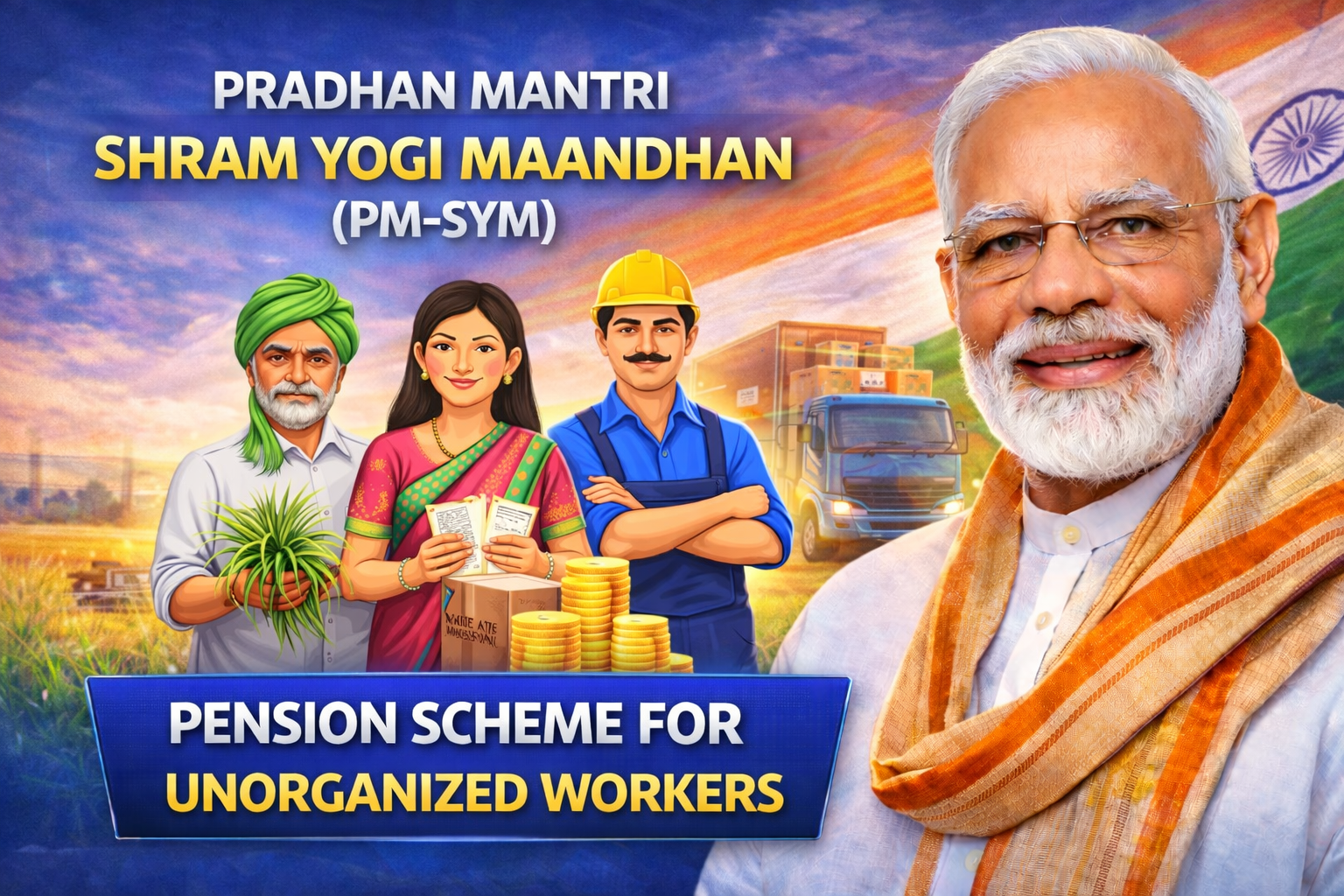
Pradhan Mantri Shram Yogi Maandhan (PM-SYM) is one of the most important social security initiatives launched by the Government of India to provide old-age income security to workers in the unorganized sector. India has a very large informal workforce that includes street vendors, rickshaw pullers, construction workers, domestic workers, agricultural laborers, and many other daily wage earners. These workers play a crucial role in the economy, but most of them do not have any formal pension or retirement benefits.
For millions of such workers, life is a continuous struggle to meet daily needs. Saving for old age is often not possible because income is low and uncertain. When they become old and are no longer able to work, they usually have to depend on their families, relatives, or sometimes even charity. This creates financial insecurity, loss of dignity, and hardship in old age.
To address this serious problem, the Government of India launched the Pradhan Mantri Shram Yogi Maandhan (PM-SYM) scheme in 2019. The scheme aims to provide a minimum assured pension of ₹3,000 per month to eligible unorganized workers after they reach the age of 60 years. The pension is provided in return for small monthly contributions made by the worker during his or her working years.
PM-SYM reflects the government’s commitment to building a strong social security system for the unorganized sector, ensuring that workers who spend their lives contributing to the economy can live their old age with dignity, security, and independence.
2. Meaning and Concept of PM Shram Yogi Maandhan
The name of the scheme has deep meaning:
- Pradhan Mantri = Prime Minister
- Shram Yogi = Worker or laborer
- Maandhan = Pension fund or contribution-based pension
- Yojana = Scheme
So, Pradhan Mantri Shram Yogi Maandhan means:
A Prime Minister-led pension scheme for workers, based on regular contributions, to provide income security in old age.
In simple words, PM-SYM is:
A government-backed, contributory pension scheme that guarantees a monthly pension of ₹3,000 after the age of 60 to unorganized sector workers who make small regular contributions during their working life.
3. Background: Why Was PM-SYM Needed?
3.1 The Reality of Unorganized Workers in India
India’s workforce is dominated by the unorganized or informal sector. This includes:
- Street vendors and hawkers
- Construction and factory helpers
- Domestic workers
- Rickshaw pullers and drivers
- Agricultural laborers
- Small shop workers and helpers
- Home-based workers and artisans
Most of these workers:
- Do not have permanent jobs
- Do not have fixed monthly salaries
- Do not get benefits like provident fund or pension
- Have irregular and low incomes
When they grow old, they often:
- Cannot work due to poor health
- Have no savings
- Become dependent on family members
- Face poverty and insecurity
3.2 Lack of Pension Coverage
Before schemes like APY and PM-SYM, pension coverage in India was mainly limited to:
- Government employees
- Organized private sector workers
This left crores of unorganized workers completely unprotected in their old age. The government recognized the need for a dedicated pension scheme specifically designed for the unorganized workforce.
3.3 The Need for a Simple and Affordable Pension Scheme
Any pension scheme for unorganized workers must be:
- Simple to understand
- Easy to join
- Affordable in terms of contribution
- Guaranteed in terms of benefits
- Backed by the government to build trust
PM-SYM was designed with these principles in mind.
4. Launch of PM Shram Yogi Maandhan
- Launched in: 2019
- Announced by: Government of India
- Implementing Ministry: Ministry of Labour and Employment
- Administered by: Life Insurance Corporation of India (LIC)
The scheme was introduced as part of the government’s broader effort to strengthen social security for workers in the unorganized sector.
5. Objectives of PM-SYM
The main objectives of PM Shram Yogi Maandhan are:
- Provide old-age income security
- Ensure that unorganized workers get a fixed monthly pension after 60.
- Reduce poverty and dependence in old age
- Prevent workers from becoming completely dependent on others.
- Encourage a culture of savings
- Motivate workers to save small amounts regularly for the future.
- Promote social justice and inclusion
- Extend social security benefits to those who are usually excluded.
- Strengthen the social security framework
- Build a more inclusive and humane welfare system in India.
6. Key Features of PM Shram Yogi Maandhan
6.1 Type of Scheme
- PM-SYM is a voluntary and contributory pension scheme.
- The worker contributes a small amount regularly.
- The government makes a matching contribution.
- After the age of 60, the worker gets a fixed monthly pension of ₹3,000.
6.2 Guaranteed Pension
- The scheme guarantees a minimum pension of ₹3,000 per month after 60 years of age.
- This pension is paid for life to the subscriber.
- After the death of the subscriber, the spouse receives 50% of the pension as family pension.
6.3 Contribution Amount
- The contribution depends on the age at which the worker joins the scheme.
- It ranges approximately from ₹55 to ₹200 per month.
- The government contributes an equal amount to the worker’s contribution.
This matching contribution makes the scheme more affordable and attractive.
6.4 Age Limit for Joining
- Minimum age: 18 years
- Maximum age: 40 years
A worker must join the scheme within this age range to be eligible.
6.5 Eligibility Conditions
To join PM-SYM, a person must:
- Be an unorganized worker
- Be between 18 and 40 years of age
- Have a monthly income of ₹15,000 or less
- Not be covered under:
- EPFO (Employees’ Provident Fund Organisation)
- ESIC (Employees’ State Insurance Corporation)
- NPS (National Pension System)
- Have a savings bank account and Aadhaar number
7. Who Are Considered Unorganized Workers?
The scheme covers a wide range of workers, such as:
- Street vendors and hawkers
- Rickshaw pullers and auto drivers
- Construction workers and laborers
- Domestic workers
- Agricultural laborers
- Brick kiln workers
- Head loaders
- Cobblers, tailors, barbers, and plumbers
- Small shop workers and helpers
This wide coverage ensures that most low-income informal workers can benefit from the scheme.
8. Enrollment Process
8.1 Where to Enroll?
Workers can enroll in PM-SYM at:
- Common Service Centres (CSCs) across the country
- Some bank branches and designated centers
8.2 Step-by-Step Enrollment
- The worker visits a CSC or enrollment center.
- Provides:
- Aadhaar card
- Bank account details
- Mobile number
- The operator enters the details into the system.
- The worker chooses the contribution option based on age.
- The first contribution is paid in cash or digitally.
- A Shram Yogi Pension Account is opened, and a pension card is issued.
- Future contributions are auto-debited from the bank account.
9. Contribution and Payment Mechanism
- Contributions are auto-debited from the worker’s bank account every month.
- The government matches the worker’s contribution.
- The total amount is invested and managed by LIC of India.
- This ensures:
- Regular savings
- Discipline
- Transparency
- Security of funds
10. Pension Benefits
10.1 Pension After 60 Years
- After reaching the age of 60 years, the subscriber receives:
- ₹3,000 per month as pension
- The pension is paid for life.
10.2 Family Pension
- If the subscriber dies:
- The spouse receives 50% of the pension (₹1,500 per month).
- After the death of both the subscriber and spouse:
- The accumulated corpus is returned to the nominee.
11. Exit and Withdrawal Rules
11.1 Exit Before 60 Years
- If a subscriber exits before 60:
- The contributed amount along with interest is returned.
- In case of death or permanent disability:
- The spouse can continue the scheme or withdraw the funds.
11.2 Normal Exit at 60 Years
- On reaching 60 years:
- The subscriber starts receiving the monthly pension of ₹3,000.
12. Role of LIC and Government
- LIC of India manages:
- The pension fund
- Investments
- Pension payments
- The Government of India:
- Provides matching contribution
- Sets policy guidelines
- Monitors implementation
- Ensures financial support and trust in the scheme
13. Importance and Benefits of PM-SYM
13.1 Old-Age Security
- Provides regular monthly income after retirement.
- Reduces dependence on family members.
13.2 Dignity and Independence
- Helps elderly workers live with self-respect and financial independence.
13.3 Affordable and Inclusive
- Very low monthly contribution.
- Government matching makes it even more beneficial.
13.4 Strengthening Social Security
- Extends pension benefits to those who were earlier excluded from any formal system.
14. Challenges and Limitations
- Low awareness among workers
- Irregular income makes regular contribution difficult for some
- Migration and lack of documents can affect enrollment
- Pension amount may be modest considering inflation in the future
15. Overall Significance of PM-SYM
PM-SYM is a major step towards building a comprehensive social security system for India’s unorganized workers. It recognizes the contribution of millions of workers who support the economy but often remain invisible in policy discussions.
16. Conclusion
Pradhan Mantri Shram Yogi Maandhan (PM-SYM) is a powerful and humane initiative aimed at ensuring that unorganized workers do not face poverty, insecurity, and neglect in their old age. By providing a guaranteed pension of ₹3,000 per month, supported by government matching contributions, the scheme offers a reliable safety net for millions of low-income workers.
Although challenges like awareness and regular contributions remain, PM-SYM represents a strong commitment to social justice, inclusion, and dignity of labor. In the long run, schemes like PM-SYM are essential for building a fair, compassionate, and inclusive India, where every worker can look forward to a secure and dignified life after years of hard work.